

Last updated: November 2026
Quick Answer
Saudi privatisation creates a defined twelve to eighteen month window between the transfer announcement and full operational integration. The strategic career decision is to work backwards from a chosen destination and use the window to build the positioning evidence that destination requires. Default acceptance closes the same window unused.
A Saudi national director walks into their CEO’s office and is told their entity will be privatised within the year. They have roughly twelve months before the transfer is operational. Most directors in that position spend nine of those months waiting for the new package. The few who use the time deliberately end up where they chose.
The first reaction to that news is rarely strategic. It is some mix of pension calculation, family conversations, and trying to read whether the entity is using Saudi privatisation to manage people out. Those reactions are valid and need their own time. This article picks up after them, where the strategic question becomes useful.
That gap, between waiting and positioning, is the work. Saudi privatisation transfer is a positioning decision wearing employment clothes. The question most directors ask, “do I accept the transfer?”, leaves the entity in control. Asking “what destination am I positioning toward, and what evidence does it require?” puts the director back in charge, and it generates the work.
Saudi Arabia’s National Privatisation Strategy is targeting $64 billion in private-sector capital investment by 2030 across 18 sectors and 220 contracts.
The National Centre for Privatisation pipeline names specific assets across multiple sectors:
- Water: 13 strategic reservoirs and 14 desalination plants
- Transport: Saudi Land Bridge rail, Abha International Airport
- Healthcare: Umm Al-Qura University Hospital
- Postal logistics: Saudi Post, now SPL
The pipeline has kept moving through 2026. Zawya reported 10 privatisation and PPP projects in the first half of the year, and the 30-year Umm Al-Qura University Hospital PPP opened for expressions of interest in July 2026.
The Public Investment Fund’s 2026-2030 strategy, approved 15 April 2026, structured investments into three portfolios and six domestic ecosystems including NEOM. Director-level roles inside these entities are being repositioned. The question is whether the director is doing the repositioning or letting it happen to them.
What does Resolution 616 actually do in a Saudi privatisation?
Resolution 616 is the Saudi Council of Ministers resolution that establishes the legal framework for transitioning employees from civil service law to labour law in sectors targeted for transformation and Saudi privatisation. Where it applies, the resolution provides wage continuity, severance protection, and a defined transition window. Application varies by entity and ministerial decree, so the specifics depend on the transfer regulations issued by the entity. The framework below describes the general shape.
The resolution was enacted in June 2021. PwC’s analysis of the cultural shift behind public sector transformation sets out the provisions. Articles 4 and 13 provide wage and benefits continuity at the point of transfer. Article 5 sets severance at 16% of basic salary per service year, capped at four months. Article 23 establishes a minimum two-year contract for transferred employees. Article 6 covers those unwilling to transfer: they remain in government roles for up to one year while alternative placement is sought, or receive severance.
The framework offers real protection. Two years of contract certainty, wage continuity, and a defined alternative-role year is a substantial runway. In practice, what placement looks like during the Article 6 year depends on the director’s existing network within the ministry and the sector rather than the resolution’s text. The protection is also the trap: directors who treat it as adequate cover rarely do the positioning work the runway was meant to enable.

Why do most directors answer the wrong Saudi privatisation question?
Most directors facing a Saudi privatisation transition answer “do I accept the transfer?” Either answer puts the entity in control. Accept, and the new shareholder decides where you fit. Decline, and Article 6 puts the ministry in control of your placement. Neither is positioning. The reverse-engineering question is different: what destination am I positioning toward, and what evidence does it require?
Saudi national directors at this level of experience are in the strongest position the Kingdom has produced. The roles that would historically have been filled by experienced expat directors on work visas are increasingly closed to that route.
Saudisation quotas, the shrinking expatriate workforce Semafor reported in October 2026, and the Saudi privatisation pipeline itself all point at the same outcome. Privatising entities need senior leadership stability, and the path to that stability runs through qualified Saudi nationals. The director reading this is negotiating from strength. The question is which option to choose between.
What is reverse engineering?
Reverse engineering is the foundational diagnostic principle behind every Total Career Solutions engagement. It works backwards from a defined destination, the target role, level, sector, and entity, to identify the evidence the director already has, what is missing, and the sequence in which to build it. It treats CVs, LinkedIn profiles, and internal positioning as outputs of a positioning decision, which is why the work starts with the destination.
Consider two directors in the same transferred entity, both inside the same twelve-month window. Director A spends the time waiting for the new package. They read the entity’s communications carefully, ask their HR director three times whether their grade will change, and accept when the offer arrives in month ten. Their positioning evidence is unchanged from the day the transfer was announced.
Director B identifies three possible destinations in month one. By month three they have narrowed to two, with explicit positioning evidence required for each. Through months four to eight they build it: a repositioned CV, two reframed LinkedIn projects, three internal conversations with incoming leadership, one external conversation at a Vision Portfolio entity. By month nine they are in active dialogue with two of the three. By month twelve they are in the destination they chose.
The difference is which question they answered.
Most directors do not reach Director B’s position because the diagnostic work (identifying three realistic destinations, and the order in which to build evidence for each) is the whole task. Capability is rarely the constraint. The diagnostic work benefits most from an outside view of the sector, which is where a coach earns their place.
What do Saudi privatisation entities look for in transferred leadership?
In a privatised entity’s first two years, the leadership the new shareholders trust is the leadership that can demonstrate they understand what changed. That trust is decided by how the pre-transfer record is framed. Twenty years described as public service reads to a new shareholder as legacy cost. The same twenty years described as institutional capability the entity still depends on reads as an asset. The framing decision happens before the transfer date.
From twenty years of leadership hiring, I can tell you the read on transferred leadership is set in the first 90 days. New shareholders read them the way an acquiring company reads target-company leadership at deal close: looking for who understands the operating change, who is positioning for the new model, and who is hoping the new model will accommodate them. By day 90, directors treated as continuity assets are already speaking the language of the new operating model, while those treated as legacy cost describe their work in the language of the entity that no longer exists.
The AOI method is how the repositioning gets done before the transfer date. AOI structures every achievement around Activity (what was done), Outcome (what resulted), and Impact (what it meant for the organisation). For a transferred director, the Activity stays largely the same. The Outcome and Impact carry the positioning work; they shift from public-service framing to commercial framing.
One worked example shows the size of the shift. A director whose pre-transfer role was leading a ministry’s digital transformation programme has this bullet on their current CV:
Before: Responsible for delivery of ministry digital transformation programme across 14 directorates.
After: Led enterprise digital transformation across 14 operating divisions, delivering a unified service platform that reduced inter-agency handover times from days to hours and established the integration architecture now serving the entity’s commercial customer base.
The shareholders see the same career described as two different candidates. The first 90 days set the read for the next two years, and the repositioning work needs to be visible from day one, which means it needs to be done before the transfer date.
Which three destinations are worth reverse-engineering toward?
There are three defensible destinations for a Saudi national director facing a Saudi privatisation transfer, and one indefensible default. The default is acceptance without positioning. The three destinations are continuity leadership inside the privatised entity, lateral move into a PIF portfolio company or IPO-bound entity, or a different sector entirely. Each requires different evidence, and the reverse-engineering work starts in month one.
Continuity leadership inside the privatised entity. Suits directors whose institutional knowledge is the entity’s operating moat, particularly in regulated or licensed activities where the new shareholder cannot easily replace deep operational expertise. The reverse-engineering question: what evidence does the new shareholder need in the first 90 days to treat you as a continuity asset rather than transferred headcount? The identity side of that shift is covered in my guide to the Saudi executive leadership transition.
Lateral move into a PIF portfolio company or IPO-bound entity. Suits directors whose capability transfers cleanly into one of the Vision Portfolio’s six ecosystems, or into one of the entities in the IPO pipeline. The six ecosystems are: Tourism, Travel and Entertainment; Urban Development and Livability; Advanced Manufacturing and Innovation; Industrials and Logistics; Clean Energy, Water and Renewables Infrastructure; and NEOM.
In February 2026, AGBI reported that up to eight PIF-linked companies had been earmarked for potential listings in 2026, including Saudi Global Ports, Sela, and Alkhorayef Petroleum. The listing market has since stalled: only three companies listed on Tadawul and Nomu in the first eight months of the year, Fortune reported in September, and analysts now expect most of the pipeline to move into 2027. For a director targeting an IPO-bound entity, a longer pre-listing period means more time to build the relationship path before the leadership team is set. The reverse-engineering question: which two or three target entities, what is the positioning evidence, who is the decision-maker, and what is the relationship path? Most of these roles never reach a public job posting; the hidden job market for senior Saudi roles is how the work gets done.
The AI and data-centre pivot inside PIF’s 2026-2030 strategy is producing its own concentration of these lateral roles. My guide to Vision 2030 AI careers maps the four employer pools the shift has created (HUMAIN, the telco-backed operators, the giga-project pivots, and the privatised and IPO-bound entities) and how construction-era delivery evidence translates into the hiring signals the new sector reads.
Different sector entirely. Suits directors whose transferred entity’s commercial trajectory does not match their direction, or whose capability is more valuable outside the PIF ecosystem than inside it. Energy, banking, professional services, the privatised education sector, and non-PIF Saudi corporates all hire senior Saudi leadership at a premium given Saudisation pressure across the private sector. The reverse-engineering question: which sector, which target employers, what evidence translates, what evidence needs building? My guide to changing career in Saudi Arabia sets out the five organisational types Saudi professionals move between.
How should directors use the Saudi privatisation transition window?
The operational reality of Saudi privatisation integration creates a transition window of roughly twelve to eighteen months between announcement and full integration, regardless of legal status under Resolution 616. Used deliberately, the window breaks into three phases: destination clarification, evidence building, and execution. If the regional conflict or a slower listing market stretches some Saudi privatisation timelines into 2027, the window gets longer, and that extra time benefits only the directors already using it.
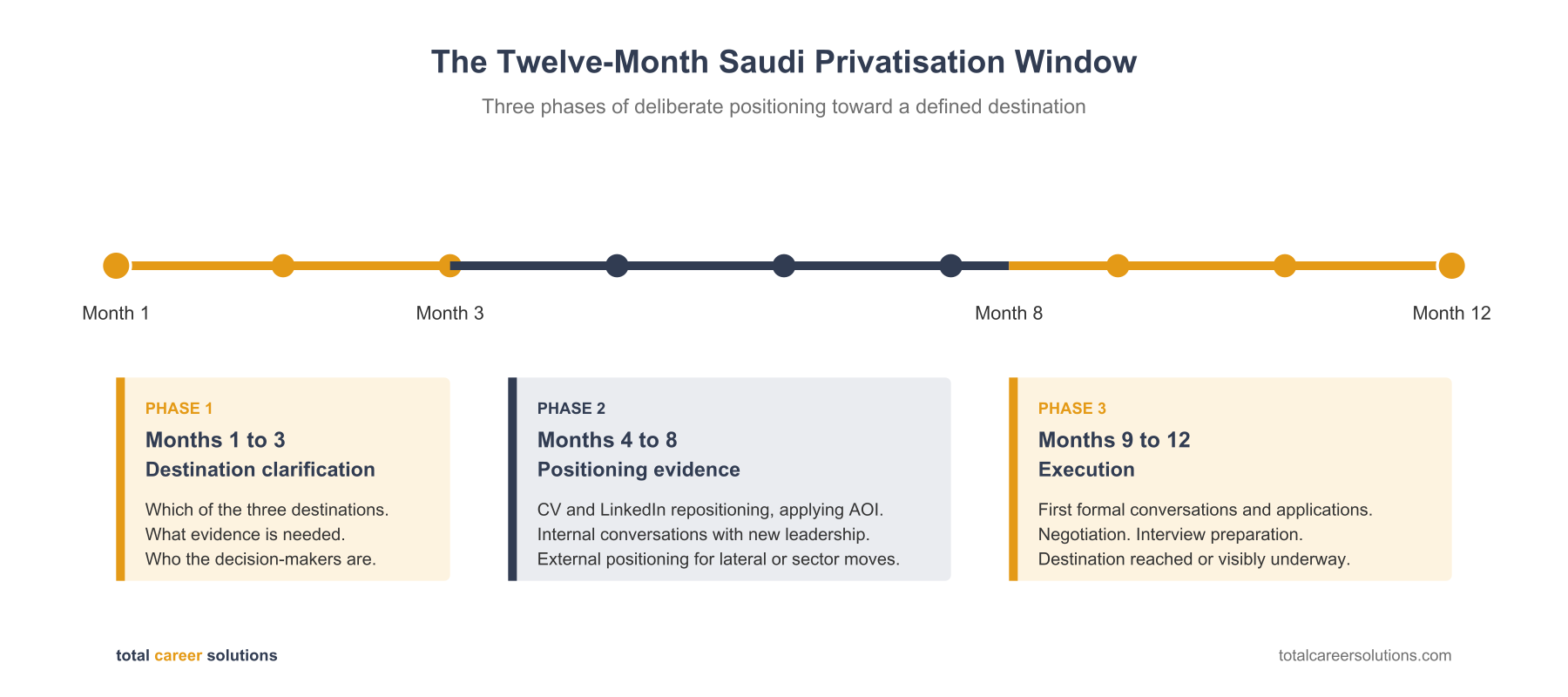
Months 1 to 3 are destination clarification. Which of the three destinations, what evidence is needed, who the decision-makers are, what relationships need building. This is the diagnostic phase, and where most directors lose the most ground, because the work is required at the moment when internal communications pull everyone’s attention toward waiting.
Months 4 to 8 are positioning evidence. CV and LinkedIn repositioning, applying AOI to every achievement bullet. Internal positioning conversations with new leadership where the destination is continuity. External positioning where the destination is lateral or sector change. By the end of month eight, the evidence should be visible to the decision-makers who matter.
Months 9 to 12 are execution. First formal conversations, applications, negotiation. By month twelve, the destination is reached or visibly underway. For directors moving externally, this is where Saudi executive interview preparation earns its place; the interview is the moment the positioning work is tested. Directors who reach month twelve still in the diagnostic phase have let the window pass.
A practical note for directors reading this late. The three-phase structure assumes a full twelve months. Directors with six months left, or three, can still use the time. The phases compress rather than disappear: faster destination clarification, parallel evidence-building, earlier first conversations. All the principle requires is that the question is asked.
What career strategy sits underneath the disruption?
When the ground under your role is moving, the discipline is to work backwards from a defined destination rather than forwards from current circumstances. Saudi privatisation creates the window in which the director decides where they end up. The directors who use it are the ones who asked the reverse-engineering question early and built the evidence in time.
Richard Bunkham FCIPD coaches Saudi national directors through career transitions across the Kingdom, drawing on twenty years in senior talent acquisition up to global head of TA level. Strategic Career Management is structured for exactly this kind of window.

Ready to reverse-engineer your Saudi privatisation career strategy?
Strategic Career Management is built for exactly this kind of structural disruption: a defined window, a deliberate destination, and the positioning work to reach it. The starting point is a free 15-minute strategy call.
The twelve-month window is your window. Most directors do not use it. The ones who do are the ones who knew which destination they were positioning toward and started the work in time. If you cannot yet name your destination, the strategy call is where that work starts.