
The Hidden Job Market in Saudi Arabia: How Directors and VPs Access Unadvertised Roles
Quick Summary
The hidden job market in Saudi Arabia fills most director and VP roles through executive search firms, referrals, and direct approaches rather than public job boards. In twenty years of senior hiring, I almost never advertised an executive search. This guide explains how that market operates and how to position yourself within it.
Reading Time: 10 minutes
Last updated: November 2026
Saudi Arabia’s transformation economy remains one of the most significant executive hiring markets in the world, but the picture is shifting. The Public Investment Fund is recalibrating its giga-project portfolio, some programmes are scaling back while others accelerate, and professionals who relied on public job postings are discovering those channels contracting first. Cooper Fitch expects Saudi hiring to contract in the fourth quarter of 2026, with several large employers asking it to slow or pause searches.
What has not changed is how senior roles are actually filled. They move through executive search firms, professional referrals, and direct approaches to known candidates, and in a period of restructuring these channels matter more than ever. This is the hidden job market in Saudi Arabia, and understanding how it operates has never been more relevant for directors and VPs targeting the Kingdom’s transformation programmes.
I spent twenty years in senior talent acquisition roles across multiple organisations and sectors, up to global head of TA level, with regional responsibility across EMEA, APAC, and LATAM, before founding Total Career Solutions. Executive searches in that career ran through search firms and referrals far more often than through advertising. The same pattern holds across major economies globally: a substantial proportion of professional roles, and the large majority of executive positions, are filled without public advertisement.
In Saudi Arabia, this dynamic is amplified. Programmes like Red Sea Global, Qiddiya and Diriyah operate alongside broader Vision 2030 delivery across dozens of sectors, while NEOM has refocused on ports, manufacturing, green hydrogen and artificial intelligence after halting work on The Line. PIF’s 2026 to 2030 strategy funds projects more selectively, which makes proven capability matter more than ever.
For directors and VPs targeting senior roles in Saudi Arabia’s transformation projects, a traditional job board strategy alone is unlikely to reach the most significant opportunities.
This guide explains how unadvertised senior hiring in the Kingdom works, which networks and search firms matter, and the systematic approach that positions you where these opportunities flow.

Kingdom Centre and Riyadh’s business district, where the hidden job market in Saudi Arabia creates significant demand for senior professionals through channels that rarely involve public job boards. Photo by Ibrahim Abdullah on Unsplash
Why Does the Hidden Job Market in Saudi Arabia Dominate Senior Hiring?
The hidden job market in Saudi Arabia dominates senior hiring because it is efficient by design. Large-scale programme delivery involving billions of riyals and aggressive timelines demands speed and proven capability over broad advertising. Hiring managers and project directors prioritise candidates they know, candidates referred by trusted colleagues, and candidates presented by retained executive search firms.
How Unadvertised Hiring Works Across Seniority Levels
Executive roles: Director, VP and senior executive positions in PIF companies and mega-projects are almost always filled through executive search firms or direct connections. When these roles do appear on public job boards, candidates are frequently pre-selected and the advertisement serves a compliance or process requirement rather than a genuine open search.
Specialised delivery roles: Senior Project Directors, Lead Engineers, and Strategic Directors at Saudi Arabia’s major transformation programmes fill predominantly through industry networks and targeted search. These are professionals with specific track records on comparable projects globally, and search firms are typically engaged to identify them directly.
Volume hiring: Even in larger-scale recruitment, the strongest positions frequently go to referrals first. Public advertising fills remaining gaps after internal and network channels have been exhausted.
Why this system exists: Saudi mega-projects need speed, and executive search firms deliver pre-vetted, qualified candidates significantly faster than public screening processes. They also need cultural trust and proven capability, which known quantities and referred candidates provide.
In high-stakes project environments, reducing hiring risk is worth the premium that search firms charge. Referral and search hiring works precisely because it cuts that risk. In two decades of senior hiring, I never once advertised a role I genuinely needed to fill quickly. The advertisement, when it appeared, served other purposes: compliance, process, optics. The hire itself was already in motion.
The urgency of accessing these channels is particularly acute for expat executives affected by Saudisation. My guide to how Saudisation is reshaping expat executive careers in the Gulf sets out why the directors and VPs who reposition now, while they still have time and leverage, secure materially better outcomes than those who wait. For senior leaders who want sustained support through a transition of this complexity, my Strategic Career Management service provides the ongoing strategic partnership these moves require.
This same dynamic shapes senior hiring in London. The City and Canary Wharf finance circuits, regulated firms operating under SMCR, the private equity and family office layers, and the headhunters who cover them all run through retained search and referral pathways rather than job boards. For senior leaders weighing the UK market, a detailed view of how London executive transitions actually move sits in my London guide.
For an overview of how coaching applies to senior careers in Riyadh, see my Riyadh guide.
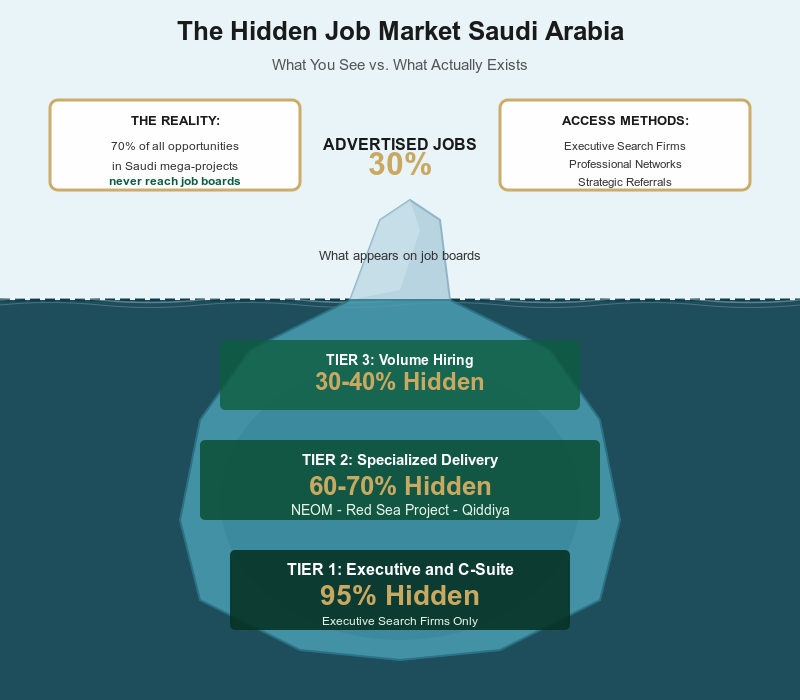
Like an iceberg, the majority of senior opportunities in the hidden job market in Saudi Arabia remain below the surface, accessible through executive search firms, professional networks, and strategic referrals.
How Do You Map Your Network for the Hidden Job Market in Saudi Arabia?
Strategic network mapping for the hidden job market in Saudi Arabia is the systematic identification of which connections, search firms, and decision-makers control access to unadvertised roles. Random LinkedIn connections do not access this market; unadvertised roles flow through specific channels you can target methodically.
Target Project Delivery Leaders, Not HR
Hiring decisions in Saudi mega-projects come from Project Directors, Chief Engineers, Technical Directors, and Business Unit Heads, not HR departments. Your LinkedIn strategy should target these roles specifically.
Advanced LinkedIn Search Strategy:
- Search for specific PIF entities and transformation programme names
- Filter by titles: “Director” / “Head of” / “VP” / “Chief”
- Review second-degree connections; these are your gateway to introductions
- Track vendor networks: major engineering consultancies and contractors often know about opportunities before they are formalised
The Strategic Approach:
- First-degree connections: Be direct about seeking insights, not jobs. Ask for 20 minutes to understand how projects recruit.
- Second-degree connections: Request introductions through mutual contacts with specific context about your interest in Saudi transformation projects.
- Cultural consideration: Respectful directness works well with Saudi decision-makers, and a request framed around learning lands better than one framed around a job.
Timing Matters: Hiring waves align with project phases. Track project announcements, contract awards, and delivery milestones: recruitment often surges in the months before major phase transitions.
The Project Delivery Team Gateway
Construction managers, engineering leads, and technical consultants are more accessible than senior executives and often know about upcoming hiring needs first. They are asked “do you know anyone who can…” on a regular basis, and being known to these professionals is one of the most effective routes into unadvertised senior delivery roles.
Sector-Specific Targeting:
- Infrastructure: Senior project engineers, BIM managers, construction directors
- Hospitality and tourism: Pre-opening teams, concept development directors
- Technology and AI: CTOs, data-centre and AI infrastructure leads, digital transformation directors
AI is now one of PIF’s stated priorities, and my guide to Vision 2030 AI careers maps the employer pools it has created.

Strategic network mapping reveals parallel pathways from your existing connections into the hidden job market in Saudi Arabia, through industry contacts and project delivery teams who know about opportunities first.
Which search firms and decision-makers should know your name?
A free 15-minute strategy call is a direct conversation about your situation, where you stand in your target market, and which part of the hidden market to work on first.
How Do Executive Search Firms and LinkedIn Open the Hidden Job Market in Saudi Arabia?
Executive search firms fill the majority of unadvertised director and VP positions in the Kingdom. LinkedIn is where those recruiters source and assess talent. Mastering both channels is essential for directors and VPs accessing unadvertised opportunities.
Key Executive Search Firms Active in Saudi Arabia
Tier 1: Global Firms with Saudi Practices. Korn Ferry, Heidrick & Struggles, Egon Zehnder, Russell Reynolds, Spencer Stuart. Director, VP, and board-level searches for PIF entities and major transformation programmes.
Tier 2: Specialist Firms with Gulf Practices. Charterhouse, Pedersen & Partners, Boyden. Engineering, infrastructure, and project delivery focus.
Tier 3: Saudi-Focused Recruiters. Michael Page Saudi Arabia, BAC Middle East, Hays Saudi Arabia. Mid-to-senior technical and specialised roles.
Getting on Executive Search Firm Radar
Wrong approach: Upload your CV to a website with a generic cover letter and wait.
Right approach: Email a specific consultant requesting a 15-20 minute insight conversation about your sector’s evolution in Saudi Arabia’s transformation. You are positioning yourself as a known entity for when relevant opportunities arise, not asking for a job.
Follow-up Strategy:
- Update quarterly, not monthly, with substantive career developments
- Share relevant insights or referrals when possible: add value before asking for it
- Engage thoughtfully with their LinkedIn content
- Be patient: search firm relationships typically take 12-18 months before opportunities align with your profile
LinkedIn Optimisation for the Hidden Job Market in Saudi Arabia
Keywords Recruiters Actually Search:
- Infrastructure: “Mega-project delivery” / “Design-build” / “FIDIC contracts” / “Multi-billion USD projects”
- Technology: “AI infrastructure” / “Data centre delivery” / “Digital transformation” / “Vision 2030”
- Hospitality: “Luxury resort development” / “Pre-opening teams” / “Ultra-luxury hospitality”
- Finance: “Sovereign wealth fund” / “PIF portfolio companies” / “Project finance”
Standout Certifications: PMP, FIDIC Accredited Practitioner, LEED/BREEAM, CFA/ACCA, Six Sigma Black Belt
Content Strategy:
Don’t post: “Looking for opportunities, open to work!” Do post: “Observations from delivering infrastructure at scale: lessons for Saudi giga-projects…” The latter positions you as a contributor with relevant expertise. The former signals availability without demonstrating value. From the hiring side of the table, that distinction determines who gets approached and who gets ignored.
Engage meaningfully with posts from PIF entities and transformation programmes. Hiring managers review commenters on high-profile posts: thoughtful, substantive comments from credentialed professionals get noticed. For more on how LinkedIn’s 360Brew algorithm now evaluates professional content, see my detailed guide.
Frequency: 1-2 posts weekly, 3-5 thoughtful comments weekly. Consistency beats volume for visibility to recruiters working the Saudi market.
Arabic content: Even basic Arabic signals cultural commitment. Write English posts and add a 2-3 line Arabic summary, checked by a native speaker before you post. This differentiates you from candidates who treat the Kingdom as just another international posting.
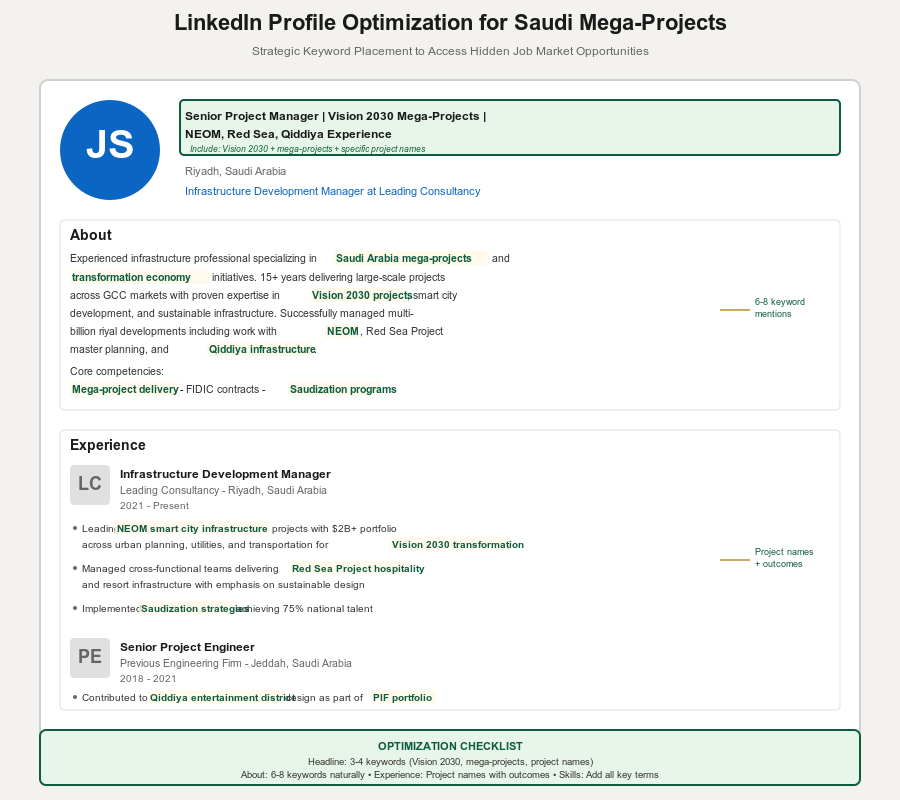
Strategic LinkedIn optimisation for the hidden job market in Saudi Arabia: where and how to integrate keywords that executive search firms and hiring managers actually use when filling unadvertised roles.
How Do Referrals Open the Hidden Job Market in Saudi Arabia?
Referrals remain the most powerful pathway into the hidden job market in Saudi Arabia for senior hiring. Most professionals approach referrals incorrectly. Here is the systematic method I have seen actually work, from both sides of the table.
Mining Your Network Strategically
The “Who Knows Someone” Approach:
Create a spreadsheet mapping:
- People you know directly
- Where they work or have worked
- Their connection to target companies or transformation programmes
Aramco Alumni (the Golden Ticket): Aramco trains world-class professionals, and many mega-project leaders are former Aramco executives. The alumni network is extensive and supportive, and it represents one of the most effective routes into senior placements in the Kingdom.
Professional Associations:
- Project Management Institute (PMI) Saudi Arabia Chapter
- Saudi Council of Engineers
- The main Saudi HR professional body for your sector
- ASCE Middle East, CIOB Gulf
The Strategic Referral Request
Wrong: “Can you refer me for a job?”
Right: “I’m interested in urban infrastructure roles in Saudi transformation projects. Would you be open to 20 minutes discussing what working on these programmes is like, what skills teams value most, and how professionals typically access these opportunities?”
Why this works:
- No pressure to vouch for you immediately
- You are asking for guidance, which is flattering and low-risk for the other person
- It opens the door for them to offer introductions if they are impressed
- It positions you as a serious, prepared candidate, not a speculative applicant
After an Informational Meeting:
- Thank-you message within 24 hours
- Share a relevant insight or article within one week
- Quarterly updates, not monthly, to maintain the relationship without being intrusive
- Offer genuine value: “I saw this report on sustainable construction, might interest your team”
Cultural Dimension:
- Relationship-led networks: Relationships build slowly but run deep. Group coffee meetings and lunches are common. Once you are “known,” the support is generous and often leads to direct introductions. This is the norm in most Saudi organisations.
- Contract-cycle networks: In international contractors and consultancies, relationships move faster and are often tied to project and contract cycles, so timing your outreach to those cycles matters more.
How Does Reverse Engineering Open the Hidden Job Market in Saudi Arabia?
The approach I use with my clients to access the hidden job market in Saudi Arabia is reverse engineering. Start with how senior roles in the Kingdom are actually filled, then work backwards to identify the specific networks, search firms, and decision-makers you need to be visible to.
What is Reverse Engineering? Reverse Engineering is the foundational approach I use with all coaching clients. Start with the target: the specific market, sector, and level you are aiming for. Then work backwards. What evidence do you need to show? Which relationships need to be in place? Which search firms need to know you? What gaps need closing, and in what order? It replaces the conventional approach of polishing what you already have and hoping it lands.
Applied to Saudi Arabia’s transformation programmes, reverse engineering produces a different action list to a conventional job search. Instead of writing CVs and applying to advertised roles, you map the search consultants who place into your target PIF entities, identify the project delivery leaders who influence hiring decisions, and build a 12-18 month visibility plan that puts you in front of those people consistently.
The CV becomes the supporting document for a strategically placed introduction, and stops being the opening move of a cold application. This is why directors and VPs who treat Saudi Arabia as a “job search” market struggle, while those who treat it as a network access problem succeed. The destination determines the approach.
What Is a 90-Day Action Plan for the Hidden Job Market in Saudi Arabia?
A 90-day action plan for the hidden job market in Saudi Arabia builds the foundation: targets, contacts and search-firm relationships. This is foundation work. Expect 6-12 months from starting to receiving offers.
Month 1: Foundation (Weeks 1-4)
Weeks 1-2:
- Network audit: map your existing connections to Saudi Arabia’s transformation economy
- LinkedIn optimisation: integrate project-specific keywords and relevant certifications
- Build a target list of 5-8 specific companies or programmes: PIF portfolio companies (such as Red Sea Global, Qiddiya, Diriyah and HUMAIN), privatised and IPO-bound entities, and Vision 2030 sector leaders
- Research: organisational structures, key leaders, recent news and contract awards
Weeks 3-4:
- Identify 3-5 decision-makers per target company
- Map second-degree connections to these individuals
- Identify the most relevant executive search firms for your sector and seniority level
- Join 2-3 professional associations active in the Saudi market
Goal: A clear target list, an optimised LinkedIn profile, and 15-20 strategic contacts identified.
Month 2: Active Engagement (Weeks 5-8)
Weeks 5-6:
- Contact 10 first-degree connections for informational discussions
- Send personalised requests to 5 second-degree strategic contacts
- Introduce yourself to a named consultant at 5 relevant executive search firms
- Post 1-2 thoughtful pieces on LinkedIn about Saudi market trends relevant to your expertise
Weeks 7-8:
- Attend 2-3 industry events (virtual, or in person where current travel advice allows)
- Engage substantively on 10-15 LinkedIn posts from target companies and their leaders
- Conduct 5-7 informational interviews
- Follow up with thank-you notes and value-add content
Goal: 5+ informational meetings, active LinkedIn engagement, and profiles submitted to search firms.
Month 3: Conversion (Weeks 9-12)
Weeks 9-10:
- Follow up with warm connections
- Request specific introductions based on earlier conversations
- Attend 1-2 more industry events
- Post expertise content relevant to your target roles
Weeks 11-12:
- For advertised roles at target companies, apply through connections, not cold applications
- Update search firms on career developments
- Schedule quarterly check-ins with your strongest connections
- Evaluate 90-day results and adjust strategy for the next quarter
Success Metrics: 3-5 active conversations about specific opportunities, a clear pathway to next steps, and a well-established presence with relevant search firms covering your sector in the Kingdom.
Reality Check: This process typically takes 6-12 months from starting to receiving offers. Professionals with existing Gulf experience or direct connections may compress this to 3-6 months. Those completely new to the Saudi market should expect 12-18 months. The 90-day plan builds the foundation; repeat and refine quarterly. If you want this structured with support, my six-session Job Search Coaching Programme works through the same phases with you. A systematic approach works; giving up after 4-6 weeks does not.
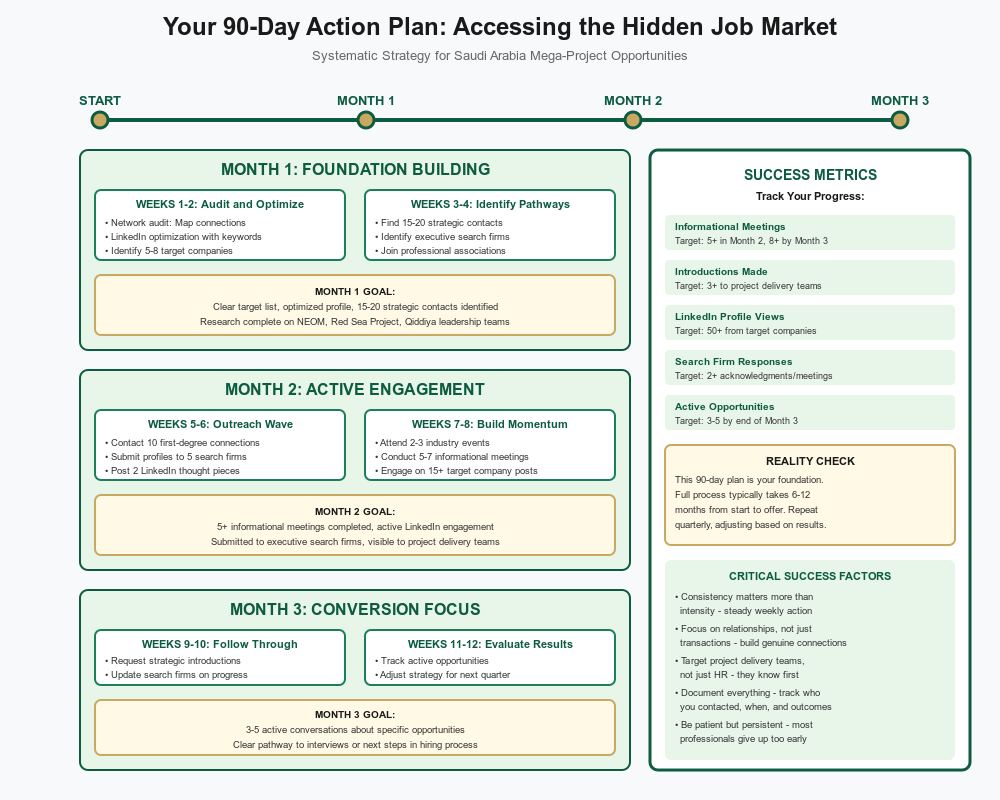
A systematic 90-day timeline for accessing the hidden job market in Saudi Arabia: the foundation of a 6-12 month strategy for senior programme opportunities.
Frequently Asked Questions About the Hidden Job Market in Saudi Arabia
What proportion of senior roles in Saudi Arabia are publicly advertised?
It varies significantly by seniority. Entry-level and mid-level positions are more frequently advertised, while senior delivery roles and executive positions are overwhelmingly filled through search firms, referrals, and direct approaches. From the hiring side, senior roles rarely make it to a job advertisement at all.
The same pattern holds across major economies, and in Saudi Arabia’s mega-project environment, where speed, confidentiality, and proven capability are paramount, this dynamic is even more pronounced. Understanding how the hidden job market in Saudi Arabia operates is essential for directors and VPs targeting senior roles in the Kingdom’s transformation programmes.
Which executive search firms are most active in the hidden job market in Saudi Arabia?
For director, VP, and board-level roles, the global firms with established Saudi practices include Heidrick & Struggles, Korn Ferry, Egon Zehnder, Russell Reynolds, and Spencer Stuart. For senior operational and delivery roles, specialist firms such as Charterhouse Partnership, Pedersen & Partners and Boyden are highly active.
For mid-to-senior technical and specialised positions, firms like Michael Page, BAC Middle East, and Hays Saudi Arabia cover significant ground. Tracking individual consultants’ LinkedIn activity and recent placements is one of the best ways to identify who is actively recruiting in your specific sector.
How long does it take to access the hidden job market in Saudi Arabia?
From initiating systematic networking to receiving offers, the typical timeline is 6-12 months. This breaks down roughly as: 1-3 months for initial relationship building and informational meetings, 2-4 months for deepening connections and getting onto search firm shortlists, and 2-3 months for active opportunity discussions, interviews, and offer negotiation.
Professionals with existing Gulf experience sometimes compress this to 3-6 months. Those completely new to the Saudi market should plan for 12-18 months. The critical factor is consistency. Professionals who maintain systematic outreach see significantly better results than those who network intensively for a few weeks and then stop.
Do Saudi nationals and expatriates need different strategies for the hidden job market in Saudi Arabia?
Yes, there are significant strategic differences. Saudi nationals benefit from deeper cultural networks: family, university, and community connections that carry substantial weight in hiring decisions. The Saudisation programme (Nitaqat) also creates structural demand for Saudi nationals across an increasing number of sectors and professions.
Expatriate professionals rely more heavily on professional credentials, executive search firms, and demonstrating specialised expertise that justifies their hire. Expats must explicitly show their value: unique technical expertise, international project experience, or knowledge transfer capabilities that support Saudisation objectives. Both groups benefit from the same core strategies (systematic networking, search firm relationships, strategic LinkedIn positioning), but the networks they activate first differ.
What if I have no existing network in Saudi Arabia?
Start with executive search firms and industry events rather than direct approaches to hiring managers. Search firms are specifically paid to find qualified candidates and are more accessible than busy project directors. Simultaneously, join professional associations active in the Saudi market: PMI Saudi Arabia Chapter, Saudi Council of Engineers, and sector-specific groups, and attend their events. On LinkedIn, identify project delivery leaders (not HR) and engage thoughtfully with their content for 4-6 weeks before requesting a connection.
The “vendor network approach” is also effective: building connections with engineering consultancies, construction firms, and technology providers working on Saudi transformation programmes, as these professionals often have direct relationships with hiring managers. If you have Gulf experience from the UAE, Qatar, Kuwait, or Bahrain, emphasise it heavily. It significantly reduces perceived relocation and adaptation risk.
How Do You Access the Hidden Job Market in Saudi Arabia Systematically?
The hidden job market in Saudi Arabia is accessed systematically: by building relationships, search-firm visibility and referrals before you need them. It exists because large-scale project delivery prioritises speed, quality, and trust over broad advertising. When billions of riyals and ambitious deadlines are at stake, hiring managers choose known quantities, trusted referrals, and pre-vetted candidates from executive search firms. I made those choices myself for two decades. The candidates I hired were almost never the ones who applied; they were the ones I or my network already knew.
It is an efficient system, and now you understand how to position yourself within it.
Directors and VPs who successfully access this market share common behaviours:
- They build relationships before needing them
- They position themselves as known entities through consistent, substantive engagement
- They understand that most of the effort happens before specific opportunities emerge
- They invest in networks, not just applications
- They demonstrate value to hiring managers and search firms proactively
Whether you are a Saudi national accelerating your career trajectory into director or VP roles within transformation projects, or an experienced expat bringing specialised expertise to the Kingdom’s most ambitious developments, the path into the hidden job market in Saudi Arabia is now clear.
This hidden market is a system, and you can access it. What decides the outcome is whether you implement these strategies systematically over 6-12 months.
Ready to build your route into the hidden market?
Fifteen minutes is enough to map where you stand and what the right next step looks like.
Related Resources: