
A Complete Guide to the Best AI Tools for Job Search
AI Resume and AI Job Searching and AI Interview Practice
Looking for the best AI tools for job search? This comprehensive guide covers everything from AI resume tips to the top AI job finder tools that can streamline your job hunt. Whether you need help with AI interview prep or want to optimize your application with an AI resume writer, we’ll show you exactly how to use artificial intelligence to land your next role.
Top AI Job Search Tools: Understanding What You Need
Before diving into specific AI Tools for Job Search and AI resume tips, it’s essential to understand how AI works in the hiring process. This knowledge will help you choose the best AI tools for job search success.
Successful AI job search strategies involve understanding two critical interactions. First, there are the AI systems that companies use to screen and evaluate candidates, including Applicant Tracking Systems (ATS), AI-powered video interview platforms, and automated skills assessments. Second, there are AI tools available to job seekers, such as resume optimizers, interview preparation assistants, and job matching platforms. Success in today’s job market requires mastering both sides of this technological equation.

Modern job search ecosystem showing how AI tools assist both job seekers and employers in the recruitment process
How Companies Use AI to Screen Candidates
Most companies use Applicant Tracking Systems (ATS) and AI tools to screen candidates. Here’s what you need to know about how these systems work:
- Initial Document Processing
- AI strips all formatting from your resume to read it as plain text
- Complex formatting, headers, footers, and special characters can confuse the system
- Tables and graphics often become unreadable
- Keyword Analysis
- AI compares your resume against the job description
- The system looks for specific terms, skills, and experiences
- Both technical skills and soft skills are analyzed
- Alternative terms and abbreviations are usually recognized (e.g., “artificial intelligence” and “AI”)
- Experience Verification
- AI scans for timeline alignment with job requirements
- Systems verify that experience matches stated qualifications
- Education and certification requirements are automatically checked
Developing Your AI-Enhanced Resume Strategy
A cornerstone of effective AI job search strategies is creating a resume that appeals to both human and artificial readers. Here’s how to achieve this balance:
Strategic Keyword Optimization for AI Systems
Modern AI job search strategies must account for how AI screening systems analyze keywords and phrases that match job descriptions. However, simply stuffing your resume with keywords isn’t effective. Instead:
- Use industry-standard terminology that AI systems recognize
- Incorporate keywords naturally within achievement statements
- Include both abbreviated and full versions of technical terms (e.g., “AI” and “Artificial Intelligence”)
- Place key terms in context with measurable results

Transform your resume through AI-powered optimization: from initial document to ATS-ready application understand how to use AI Tools for Job Search
Formatting Strategies for AI Success
Your AI job search strategies should include proper document formatting. Follow these guidelines:
- Submit your resume in PDF format to preserve formatting across all systems
- Use a clean, single-column layout that ATS systems can easily read
- Include a clear skills section with relevant keywords from the job description
- Avoid headers, footers, and special characters that can confuse ATS systems
- Name your file professionally (e.g., “FirstName_LastName_Resume.pdf”)
Understanding and Mastering AI in Your Job Search
How AI Reviews Your Resume: Behind the Scenes
Before jumping into tactics, let’s peek behind the curtain at how AI screening systems actually read your resume. Think of it as a sophisticated matchmaking system:
- Initial Scan: The AI strips away all formatting to read your resume as plain text. Those fancy graphics and complex tables? They might actually work against you. Clean, simple formatting wins every time.
- Keyword Analysis: The system hunts for specific terms from the job description. For instance: Job posting: “Experience in developing and executing digital marketing campaigns” What AI seeks: “digital marketing,” “campaign development,” “campaign execution”
- Experience Mapping: AI looks for proof you meet key requirements. If a job needs “5+ years of marketing experience,” it searches for dates and roles that confirm this timeline.
Industry-Specific Examples
Technology Roles
Before: “Worked on machine learning projects” After: “Designed and implemented 3 machine learning models using TensorFlow and PyTorch, achieving 94% prediction accuracy and reducing processing time by 60%”
Sales Positions
Before: “Exceeded sales targets” After: “Consistently surpassed quarterly sales targets by 128%, generating $3.2M in new business through strategic account development and solution-based selling approaches”
Project Management
Before: “Managed multiple projects” After: “Led cross-functional teams of 8-12 members in delivering 5 enterprise-scale digital transformation projects, all within budget and ahead of schedule by an average of 2 weeks”
Best AI resume writer : Free and Paid Options
Free AI Resume Writer Tools and How to Use Them
Using an effective AI resume writer requires leveraging the right tools. Here’s how to use them strategically:
Several platforms can help optimize your resume as part of your AI job search strategy:
- ChatGPT Effective prompts for resume optimization:
"I'm applying for [specific role]. Here's the job description: [paste JD] and my current resume: [paste resume]. Please:

- Identify key missing keywords

- Suggest ways to quantify achievements

- Recommend industry-specific terminology

- Highlight gaps in qualifications" - Google’s Gemini Use for:
- Job market research
- Industry terminology verification
- Salary range analysis
- Company research
- LinkedIn’s AI Features
- Skills Assessment tools
- Job matching algorithms
- Network recommendations
Paid AI Resume Writer Tools: Features and Limitations
- JobScan: ($49/month) Pros:
- Direct ATS compatibility checking
- Specific keyword match scoring
- Format optimization
Limitations:
- Cost may be prohibitive
- Some features available in free tools
- Results can be overly rigid
- Resume Worded: ($39/month) Pros:
- Detailed scoring system
- Industry-specific suggestions
- LinkedIn profile optimization
Limitations:
- Monthly subscription required
- Generic suggestions for some industries
- Limited customization options
Grammarly: While known primarily as a grammar checker, Grammarly’s AI can help ensure your resume maintains a professional tone and reads naturally while being optimized for AI systems.
AI Resume Writer Tools to Enhance Your Job Search Strategy
Common Pitfalls to Avoid when using AI Resume Writer Tools
- Keyword Stuffing
- Don’t force keywords unnaturally
- Avoid invisible text or excessive repetition
- Maintain readability for human reviewers
- Over-Formatting
- Avoid complex tables or graphics
- Don’t use text boxes or multiple columns
- Skip custom fonts or characters
- Generic Descriptions
- Avoid vague achievements
- Don’t use cliché terms without context
- Skip buzzwords without supporting evidence
Measuring Success
Track these metrics to gauge your strategy’s effectiveness:
- Application Metrics
- ATS compatibility score
- Keyword match rate
- Application-to-response ratio
- Response Tracking
- Time to first response
- Interview invitation rate
- Final stage interview rate
- Optimization Opportunities
- Most successful resume versions
- Most effective keyword combinations
- Best-performing application channel
Your AI Powered Job Search Action Plan: Essential Steps
Establish Your Baseline
Start by understanding exactly where you stand:
- Run your current resume through AI Tools for Job Search such as JobScan or Resume Worded for an initial match rate. This gives you a concrete starting point and helps identify gaps between your current resume and job requirements.
- Save your original resume as a reference point. You’ll want to track your improvements and might need different versions for different roles.
- Make note of your current match rate. Most successful candidates achieve at least a 75% match rate with job descriptions.
Strategic Job Analysis
Analyze target positions to understand what AI systems are seeking and AI Tools for Job Search are working for you:
- Choose three ideal job postings that represent your target role. Looking at multiple postings helps identify patterns in what employers consistently value.
- Create a list of common keywords appearing across these postings. These recurring terms represent core requirements in your field.
- Pay special attention to technical skills, certifications, and specific experience requirements. These are often non-negotiable items that AI screens for first.
Resume Optimization
Transform your resume with purpose ensue that the AI Tools for Job Search that you are using get you the best results:
- Update your professional summary to include the most crucial keywords you’ve identified. This section gets scanned first by both AI and humans.
- Naturally incorporate missing keywords into your experience bullet points. Remember to maintain readability – forced keywords are obvious to human readers.
- Add a skills section that mirrors the job requirements closely. This gives AI systems an easy-to-scan list of your qualifications.
Profile Alignment
Ensure consistency across all your job search materials:
- Update your LinkedIn profile to match your optimized resume. Recruiters often cross-reference these, and inconsistencies raise red flags.
- Adapt your cover letter template to include key terms. Yes, AI often screens these too!
- Review and update any other professional profiles or portfolios for consistency.
Application and Tracking
Monitor and improve your success rate:
- Submit applications using your newly optimized materials. Each application is a chance to test your optimization.
- Keep track of your match rates and responses. This data helps you refine your approach.
- If you’re not getting responses, revisit your keyword optimization and make adjustments.
The goal isn’t just to pass AI screening but to present yourself authentically while speaking the language that both AI and employers understand. Each step builds on the previous one, creating a strong foundation for your job search success.
This process isn’t about gaming the system – it’s about effectively communicating your qualifications in today’s digital-first job market. The key is to maintain your authentic professional story while ensuring it’s understood by both artificial and human intelligence.
AI interview Practice Strategies
A comprehensive AI job search strategy should includes AI interview practice. The STAR Method offers an AI-powered platform that helps you structure your interview responses using the Situation, Task, Action, Result framework. These tools help you:
- Practice with AI-simulated behavioral interviews
- Receive analysis of your speech patterns and body language
- Get customized feedback on your response structure and content
- Build a library of strong STAR-format stories for common interview questions

See how AI-optimized job search strategies can dramatically improve your application success rates and response times
Free AI Interview Practice Tools: Your Digital Interview Coach
The landscape of interview preparation has been transformed by artificial intelligence, with several powerful tools now offering sophisticated practice environments at no cost. Understanding how these AI-powered platforms work can help you maximize their benefits for your interview preparation.
Google Interview Warmup: Inside Your AI Interview Practice Partner
Google Interview Warmup functions as an AI-powered conversation partner that helps you practice and refine your interview responses. The system works by analyzing three key aspects of your answers through sophisticated natural language processing: content quality, expression patterns, and professional terminology.
When you speak or type your response, the AI processes your answer by examining several elements simultaneously:
Content analysis examines the structure and completeness of your responses. For instance, when answering a question about a challenging project, the AI looks for key components such as the situation you faced, the actions you took, and the results you achieved – mirroring how human interviewers evaluate responses.
Expression analysis focuses on your communication style, identifying patterns in your language use, including repetitive phrases, filler words, or areas where you might be underselling your achievements. This continuous feedback helps you develop more polished and professional responses.
Terminology analysis compares your language against industry-specific vocabularies, ensuring you’re using professional terms appropriately and in context.
LinkedIn’s AI-Powered Interview Preparation
LinkedIn Premium’s Interview Preparation takes a different approach by integrating with your professional profile to create a personalized practice experience. The system analyzes your work history, skills, and industry to generate relevant interview scenarios.
Here’s how LinkedIn’s system enhances your interview preparation:
Profile Integration: The AI analyzes your LinkedIn profile to understand your professional background, creating custom questions based on your experience level and industry.
Real-Time Feedback: The system provides immediate feedback by comparing your responses against successful answer patterns from your industry, helping you align with proven approaches while maintaining authenticity.
Skills Assessment: LinkedIn’s AI combines data from your completed skills assessments to generate technical questions relevant to your field.
The Technology Behind AI Interview Practice
These platforms employ several sophisticated technologies to evaluate your responses:
Speech Recognition: Converts spoken answers into text for analysis
Natural Language Processing: Analyzes content for relevance and completeness
Machine Learning Models: Identifies patterns and provides feedback based on successful interview responses
Making the Most of Free AI Interview Practice Tools
To effectively use these tools in your interview preparation:
Start with Google Interview Warmup for general practice and baseline skill assessment. Focus on understanding the AI’s feedback about your communication patterns and professional terminology.
Progress to LinkedIn’s industry-specific questions to deepen your preparation. The platform’s integration with your professional profile enables more targeted practice scenarios aligned with your career path.
Understanding AI Tools for Interview Practice Limitations and Best Practices
While powerful, these AI Tools for Interview practice work best when you understand their scope:
Pattern Recognition: The AI analyzes responses based on general best practices but can’t account for company-specific culture or individual interviewer styles.
Feedback Framework: The systems provide guidance based on pattern recognition from successful interviews but might not recognize unique or innovative approaches that could work well in person.
Additional Free Interview Resources
Several other platforms offer complementary features:
Pramp – Specializes in technical interview preparation
Big Interview – Offers basic AI analysis of behavioral questions
InterviewBit – Provides technical interview practice with AI feedback
Remember that these tools serve as practice aids rather than replacements for human interaction. Regular practice with thoughtful integration of AI feedback helps develop stronger interview skills while maintaining your authentic professional voice.
Implement Your AI Job Search Strategy Today
Ready to transform your job search with AI-powered strategies? As an experienced career coach and Fellow of the Chartered Institute of Personnel and Development (FCIPD), I offer practical, results-focused guidance to help you implement effective AI job search strategies and help you understand which AI Tools for Job Search work best for you.
Book Your Complimentary Career Discovery Call
Join me for a focused 15-minute discovery call where we will:
- Identify your key career goals and challenges
- Discuss one practical strategy you can implement immediately
- Explore how my pragmatic coaching approach can help you find your dream job
My approach is straightforward and results-oriented. I focus on helping you develop sustainable career strategies that lead to long-term success, not just quick fixes. Through our work together, you’ll learn how to navigate both traditional and AI-driven recruitment processes effectively.
SCHEDULE YOUR 15-MINUTE DISCOVERY CALL
Limited availability each week. Book your slot today to begin your journey toward career success.
Client Success Stories
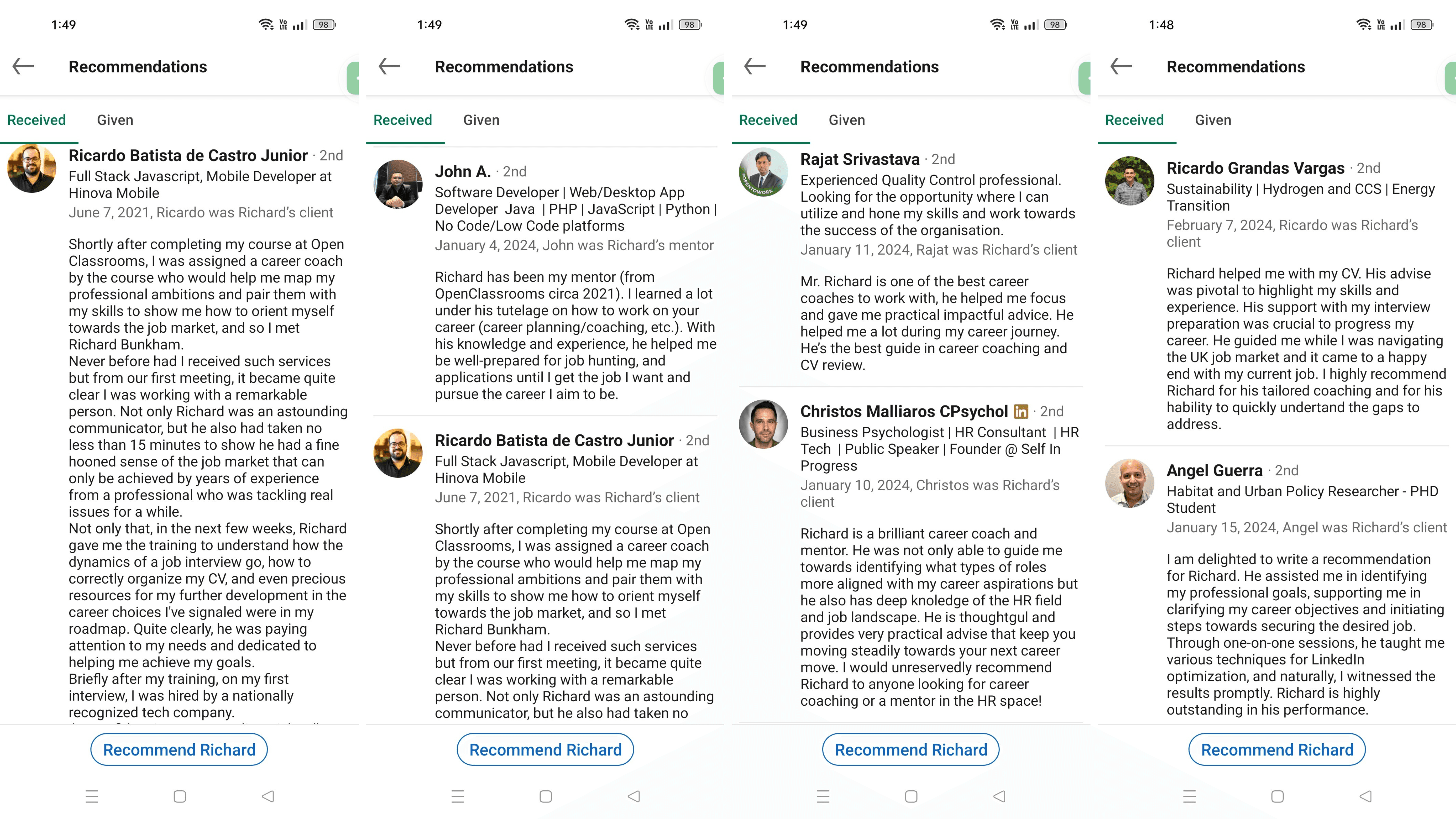
why should we hire you Success stories
Book an initial free consultation
Free 15 minute career coaching consultation. Find out how career coaching can help you to get the job you really want.