
In brief: The STAR interview method is a structured approach to answering behavioural interview questions using four components: Situation, Task, Action, and Result. Action should account for roughly half your answer because that is the section where the interviewer assesses your actual capability. This guide explains how to use the framework, how to time your answers, and the three mistakes that most commonly cost candidates the job.
Reading time: 6 minutes | Last updated: March 2026
With over twenty years conducting interviews — including as Global Head of Talent Acquisition at a multinational — I have watched thousands of candidates answer behavioural questions. The ones who use the STAR interview method well stand out immediately. Not because the framework is complicated, but because it imposes structure on a type of question that otherwise causes people to ramble, lose their thread, or bury their strongest achievements under unnecessary detail.
Behavioural questions feel harder than they are because they require you to recall, select, and structure a story under pressure. The STAR interview method exists precisely to reduce that cognitive load — it gives you a reliable shape for any competency-based question, so your brain can focus on content rather than structure.
If you are preparing for interviews at director level and above, this guide covers the fundamentals. For executive-level STAR preparation — including what hiring managers actually evaluate at senior level and annotated examples from the hiring side — see our dedicated guide to the STAR method for executive interviews.
What Is the STAR Interview Method?
The STAR interview method is a strategy for answering behavioural interview questions — the ones that begin with “tell me about a time when…” or “give me an example of…” — used widely across industries and endorsed by sources from the Harvard Business Review to professional coaching bodies. It gives you a four-part structure that ensures your answer is complete, focused, and evidence-based.
STAR stands for Situation, Task, Action, and Result. Each component plays a specific role, and each should take up a defined proportion of your response. Understanding why the proportions are weighted as they are matters as much as memorising the percentages — it is the difference between following a formula and understanding what the interviewer actually needs to hear.
The STAR Breakdown: How Much Time to Spend on Each Component
Situation (20% of your answer) — set the scene. Establish the context so the interviewer understands the challenge you faced. Include the time frame, the scale, and the business impact. Keep it to two or three sentences. The interviewer wants to understand the stakes, not hear the full backstory. From the hiring side, I can tell you: candidates who spend too long on the Situation almost always run out of time for the Action, which is the section that actually determines whether they get the job.
Task (10% of your answer) — define your role. Explain your specific responsibility within that situation. Focus on your part, not the broader team brief. This is the shortest section of your answer — a single sentence is often sufficient.
Action (50% of your answer) — this is the core, and there is a reason it accounts for half your response. The Action is where the interviewer assesses your actual capability. The Situation and Task provide context. The Result provides evidence. But the Action is where they decide whether you can do the job. Detail how you assessed the situation, the steps you took, and the decisions you made. Use “I” rather than “we” to make your personal contribution clear. Avoid industry-specific jargon — your interviewer may not be a subject matter expert in your field.
Result (20% of your answer) — quantify the outcome. Describe the positive results your actions achieved. Where possible, use numbers: percentage improvements, cost savings, revenue generated, or time saved. From the hiring side, the candidates who stand out are the ones who go beyond “what happened” to “what it meant” — not just “we hit the target” but “we hit the target, which secured the contract renewal and protected £1.2M in annual revenue.” Tangible results with business context transform a good answer into a memorable one.

A visual guide showing the STAR interview technique’s four components: Situation (20%), Task (10%), Action (50%), and Result (20%) with recommended response times.
The STAR Interview Method in Action: A Worked Example
Question: “Tell me about a time you improved a process or system that was underperforming.”
Situation: “In my role as operations manager at a UK logistics firm, our client onboarding process was taking an average of fourteen working days — significantly longer than the industry standard of five to seven days. We were losing prospective clients at the proposal stage because competitors could start service delivery faster.”
Task: “I was responsible for diagnosing where the delays were occurring and redesigning the process to bring onboarding within the industry benchmark.”
Action: “I mapped the existing process end to end and identified that the primary bottleneck was a manual compliance check that required sign-off from three separate departments. I proposed consolidating the check into a single cross-functional review meeting held twice weekly, which I set up and chaired for the first two months. I also created a standardised onboarding checklist that eliminated the duplicate data entry our team had been doing across two systems. When the finance team initially resisted the consolidated review — they were concerned about losing oversight — I worked with their team lead to build in a specific reporting mechanism that addressed their concern without reintroducing the delay.”
Result: “Onboarding time dropped from fourteen days to six within three months. The following quarter, our conversion rate from proposal to signed contract increased by 18%, which the sales director attributed directly to the faster onboarding. The consolidated review format was subsequently adopted by two other departments for their own approval processes.”
Notice how the Action section is the longest and most detailed part of the answer. That is deliberate — it is where the interviewer is doing most of their assessment. Notice also that the Result goes beyond the immediate metric (onboarding time) to the commercial impact (conversion rate, wider adoption). That second layer is what separates a competent answer from a strong one.
Timing Your Response
A well-structured STAR interview method answer typically runs between ninety seconds and three minutes. The exact length depends on the complexity of the question, but the proportions should stay consistent regardless of duration: keep the Situation and Task brief, give the Action the majority of your time, and land the Result with enough weight to leave an impression.
The most reliable timing guide is proportional rather than absolute:
Situation: two or three sentences — just enough to establish the stakes.
Task: one sentence — your specific responsibility.
Action: this should account for at least half your total answer — it is the section where the interviewer forms their assessment.
Result: two or three sentences — the outcome and what it meant.
If your answer is running past three minutes, you are almost certainly spending too long on the Situation — the most common timing error I see from the hiring side. If it is under ninety seconds, your Action section needs more depth. A well-structured STAR answer should also set up a follow-up question the interviewer wants to ask — if the panel leans in with “tell me more about how you handled the resistance from finance,” that is a sign your answer landed well.
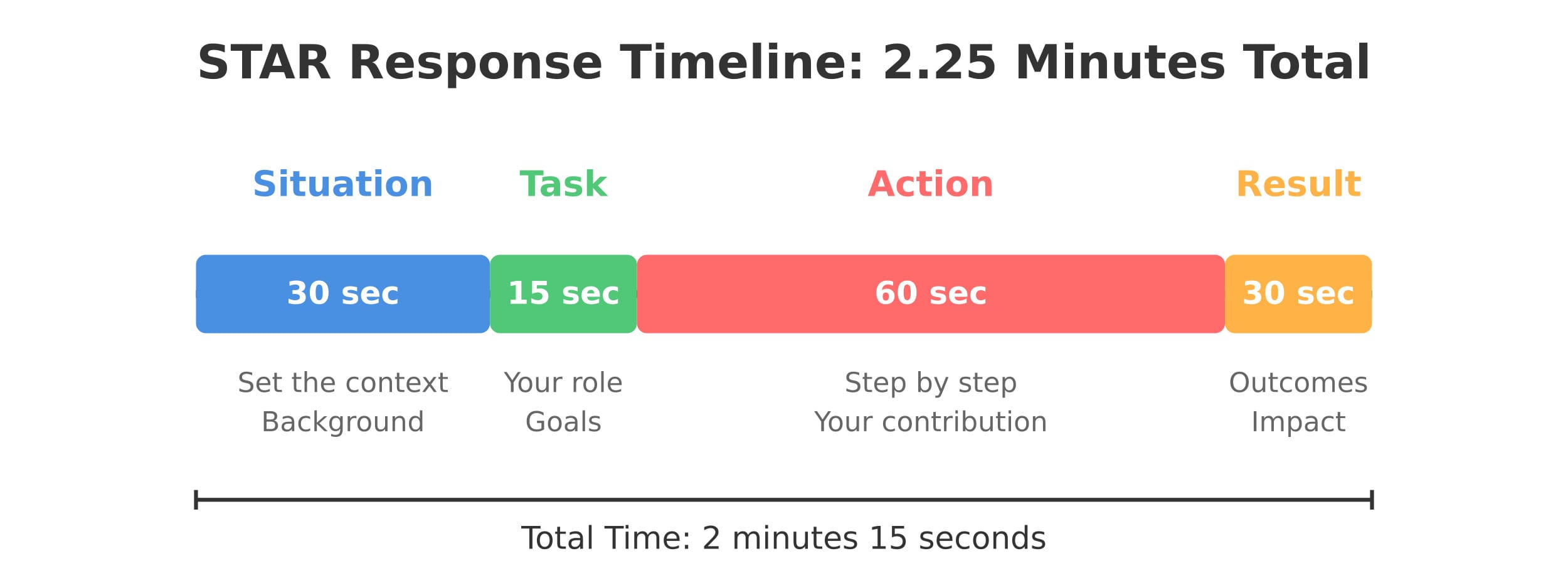
Recommended timing for delivering a powerful STAR method response in behavioral interviews
Three Common STAR Interview Method Mistakes
Mistake 1: Choosing the wrong example. This is the most fundamental error and the one I see most frequently from the hiring side. Candidates default to their most impressive achievement rather than the achievement most relevant to the competency being assessed. If the interviewer asks about a time you influenced a difficult stakeholder, they do not want to hear about the time you delivered a project under budget — even if that project was more impressive overall. Match the example to the question. If the fit is not obvious within the first two sentences, the interviewer has already mentally moved on.
Mistake 2: Vague situations that waste your time budget. If your Situation is too general, the interviewer cannot assess the complexity of what you achieved — and you have burned thirty seconds of your answer on content that adds nothing. Use the “WWW” approach: What happened, Where it happened, and When it happened. “In my previous role, there was a problem with a project” tells the interviewer nothing. “In Q3 last year, our largest client threatened to move their £2M annual contract to a competitor” tells them everything they need in one sentence, leaving you more time for the Action where it counts.
Mistake 3: Too much “we,” not enough “I.” Team context matters, but the interviewer needs to assess your individual contribution. A useful rule: describe the team context in the Situation, but use “I” throughout the Action section. “We reorganised the department” does not tell the panel what you did. “I proposed the new structure, secured sign-off from the leadership team, and personally managed the transition of twelve staff into new roles” does. The interviewer is not asking what your team achieved — they are asking what you contributed.

Master the I vs. We balance to showcase both leadership and teamwork in your interview responses
Preparing for STAR Interviews
Study the job description and identify the core competencies being assessed — leadership, problem-solving, stakeholder management, commercial awareness, and similar. For each competency, prepare one strong example from your career. The critical discipline is to select your example based on what the interviewer needs to hear, not on what you most want to talk about. Start with the competency, then find the best match from your experience — not the other way around.
Structure each example using STAR and practise delivering it aloud. If your listener — a friend, a family member, a colleague — gets lost at any point, that section needs tightening. Practising with someone who can challenge your answers and point out where you are being vague or spending too long on context produces significantly better results than practising alone. For structured preparation with expert feedback, our mock interview coaching gives you the opportunity to rehearse STAR answers in a realistic setting with a professional who has conducted thousands of interviews and knows what the panel is listening for.
For a broader guide to interview preparation covering both behavioural and situational questions, virtual interview setup, and post-interview follow-up, see our complete guide to acing job interviews.
Want Expert Feedback on Your Interview Answers?
Book a free 15-minute consultation to discuss how one-to-one interview coaching can help you walk into your next interview with confidence.