
Why Did You Leave Your Last Job? Best Answers for This Common Interview Question
“Why did you leave your last job?” is one of the most common yet challenging interview questions you’ll face. How you answer can significantly impact your chances of securing a new role. When interviewers ask about why did you left your last job, they’re gaining insight into your work values, professional judgment, and how you handle career transitions.
We all have different reasons for leaving a job, in this guide, we’ll explore how to craft honest, professional responses that present your career journey in the best light—regardless of whether your departure was voluntary or not. For comprehensive career guidance beyond this question, check out The Career Change Handbook for strategies on navigating all aspects of professional transitions.
Why Interviewers Ask About Why You Left Your Last Job
When an interviewer asks why did you leave your last job, they’re typically looking to:
- Assess your professional judgment and decision-making
- Understand your career values and priorities
- Gauge how you handle workplace challenges
- Identify potential red flags or patterns
- Determine if you’ll be a good fit for their company culture
Your answer to why did you leave your last job reveals much more than just your reason for leaving—it demonstrates your professionalism, emotional intelligence, and ability to communicate difficult topics tactfully.
This question also serves as a window into your career narrative. Recruiters and hiring managers want to see if you make deliberate, thoughtful choices rather than impulsive decisions. They’re evaluating whether your departure makes sense within your larger career story and whether the opportunity they’re offering aligns with your trajectory.
Additionally, how you speak about previous employers when explaining why you left your last job signals how you might eventually speak about their organization. If you criticize or blame your former workplace, they may worry you’ll do the same to them in the future. Conversely, if you frame your departure in terms of growth and opportunity, you present yourself as someone who takes ownership of their career development and maintains professional relationships even through transitions.
The psychology behind asking the question goes deeper than just understanding your employment history. It reveals your resilience, adaptability, and how you handle change—all critical factors in today’s rapidly evolving workplace. Companies want employees who can navigate transitions smoothly and learn from every professional experience.
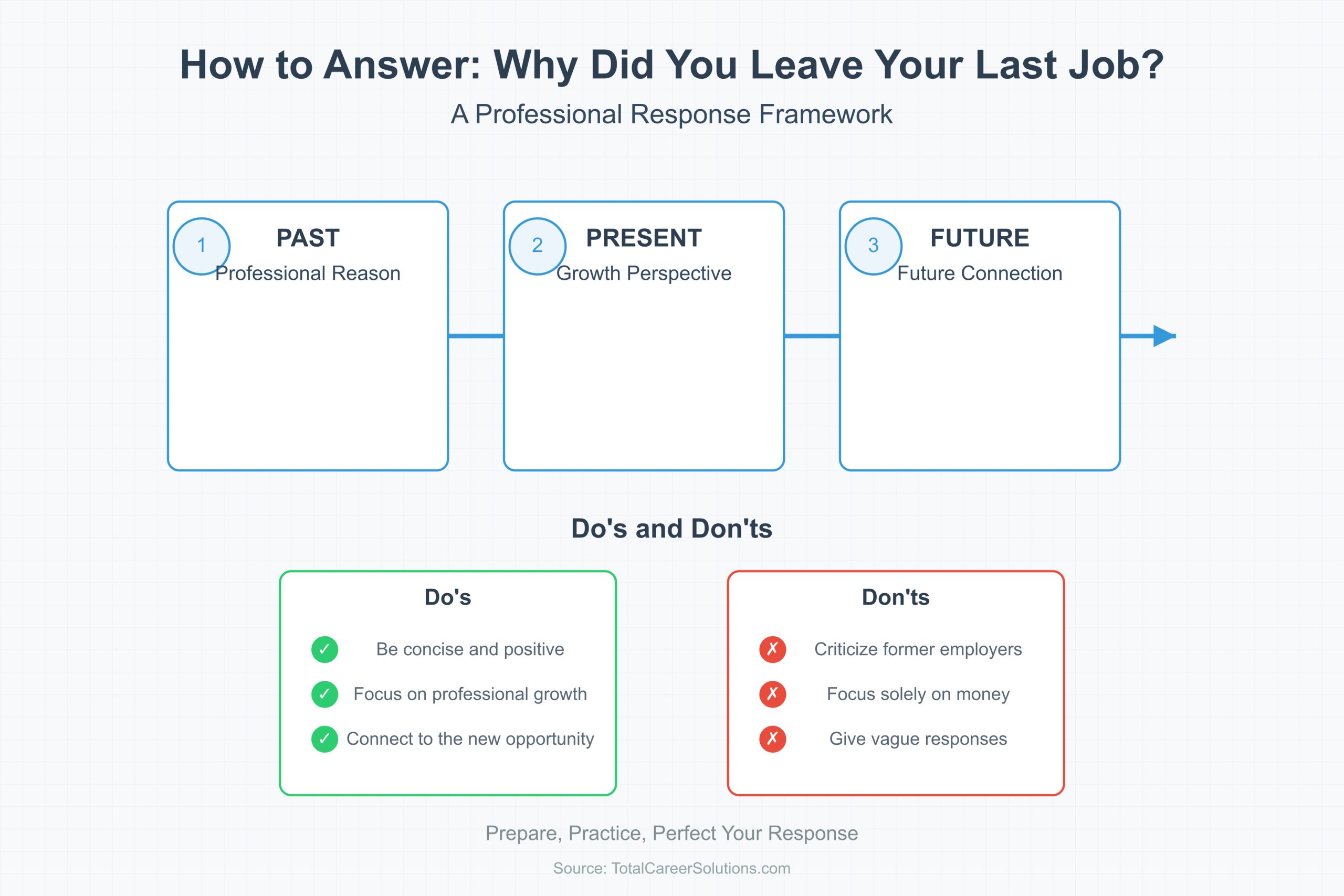
The ideal 3-part structure for explaining why you left your last job in job interviews: professional reasons, lessons learned, and connection to new opportunities.
Professional Example Answer : Why Did You Leave Your Last Job?
Career Growth and Development Reasons
“I left my last job after three years because I had reached the ceiling for growth. I had increased department efficiency by 15%, but the company structure didn’t offer advancement opportunities aligned with my career goals. I’m excited about this position because it offers the leadership responsibilities I’ve been preparing for.”
“I left my previous position to pursue opportunities that would allow me to develop new skills. While I developed strong foundations in marketing analytics at ABC Company, I wanted to expand into content strategy and campaign management, which aligns perfectly with this role.”
For more examples of effective career advancement strategies, check my Career Coaching Services. We can help you develop a personalized strategy for explaining your career transitions in ways that highlight your professional growth and adaptability.
Organizational Changes and Transitions
“I left my last job because my role changed significantly from what I was hired to do. I was brought on to lead digital transformation initiatives, but after a company reorganization, my role shifted primarily to maintenance work. I’m looking for a position where I can fully utilize my innovation and implementation skills.”
“I left my last job after successfully completing the specific project I was hired for. After implementing the new CRM system, training staff, and documenting processes, it was a natural transition point. I’m proud of delivering that project on time and under budget, and I’m now seeking new challenges like those outlined in this position.”
“The reason I left my last job was a significant shift in the company’s direction. When I joined, they were committed to expanding sustainability initiatives, which aligned with my values and expertise. However, new leadership shifted priorities away from these projects. I’m excited to see your company’s commitment to sustainability in your recent annual report.”
Life Circumstances and External Factors
“I left my last job because my family relocated to this area. My partner received a significant career opportunity here, and after careful consideration, we decided to move. I’m now seeking local opportunities where I can continue my career in healthcare administration, which is why your hospital’s reputation for excellence caught my attention.”
“I left my last job during a company-wide restructuring where my entire department was eliminated, affecting 15% of the workforce. Before leaving, I ensured all my projects were properly transitioned and documented. This experience reinforced my adaptability, and I’ve since enhanced my skills in [relevant area], making me well-prepared for this position.”
How to Answer Why Did You Leave Your Last Job
Crafting Your Response Strategy
Honesty is essential, but that doesn’t mean sharing every detail when discussing why you left your last job. Focus on the professional aspects of your departure rather than personal grievances.
Example framework for answering why did you leave your last job: “I left my position at [Company] because [primary professional reason]. During my time there, I [key accomplishment]. Now, I’m looking for opportunities where I can [future-oriented goal related to the position].”
Discover more interview preparation strategies in Total Career Solutions’ Preparation Success Guide.
Common Pitfalls to Avoid
Negativity and Blame
Poor response: “My last boss was impossible to work with and constantly undermined me.” Better approach: “I thrive in environments with clear communication and collaborative leadership, which I understand is a cornerstone of your company culture.”
Focusing Only on Compensation
Poor response: “They weren’t paying me what I was worth, so I left.” Better approach: “I was seeking a role that offered both competitive compensation and opportunities for professional growth, which this position seems to provide.”
Special Circumstances When Explaining Why You Left Your Last Job
When you’ve been laid off and need to explain why you left your last job: “I left my last job when my position was eliminated during a company-wide restructuring where my department was reduced by 30%. While disappointing, I’m proud of the work I accomplished there, including [specific achievement]. This transition has allowed me to focus on opportunities like this one, where my experience in [relevant skill] can add immediate value.”
When you were terminated and must address why you left your last job: “My position at my last job was terminated due to [brief objective description]. While challenging, this experience helped me reflect on areas where I could improve. I’ve since enhanced my project management skills through certification and am looking for roles where I can apply these strengthened abilities. I appreciate the emphasis your job description places on structured project management.”
When you left without another job and need to explain why you left your last job: “I left my last job after careful financial planning to focus on finding the right opportunity rather than the quickest one. During this time, I’ve [enhanced skills, volunteered, consulted, etc.], which has given me clarity about wanting a role exactly like this one.”
For additional tools to help you prepare to get a new job check out our Resume Builder.
Preparation Techniques for Answering Why Did You Leave Your Last Job
Practice your response the question aloud until it sounds natural, not rehearsed. Your tone should be matter-of-fact and confident, without defensiveness or negativity.
Consider recording yourself answering “why did you leave your last job” and other common interview questions, then review for areas of improvement. A mock interview with a trusted colleague can provide valuable feedback on both your content and delivery.
Many job seekers find it helpful to use the STAR method (Situation, Task, Action, Result) when structuring their response to the question.
- Situation: Briefly describe the context at your previous job
- Task: Explain what you were trying to accomplish
- Action: Detail the positive steps you took regarding your departure
- Result: Connect your departure to the positive outcome of pursuing this new opportunity
For example: “At my previous company (Situation), I was seeking to advance my project management skills (Task). After discussing growth opportunities with my manager and finding they were limited due to company size, I decided to pursue roles with larger organizations that could support my professional development (Action). This led me to your company, which is known for its robust project management framework and advancement paths (Result).”
It’s also beneficial to prepare different versions of your answer to why did you leave your last job for various interview formats:
- Phone screen version: Brief and focused on key professional factors
- First interview version: More detailed, with specific examples
- Panel interview version: Emphasizes teamwork and organizational fit
- Executive interview version: Highlights strategic thinking and long-term career vision
Remember that career transitions are normal and expected. According to the Bureau of Labor Statistics, the average person changes jobs 12 times during their career. In fact, 32% of workers typically stay in a job for less than two years, making job changes a common topic in interviews.
What matters isn’t that you left your previous position, but how you frame that transition as part of your professional growth story. By preparing a concise, positive, and forward-looking response, you transform a potentially tricky question into an opportunity to demonstrate your professionalism, self-awareness, and career intentionality.
Final Considerations When Answering
Industry context can significantly impact how you should frame your answer. For example, in highly regulated industries like healthcare or finance, emphasizing your commitment to compliance and ethical standards may be particularly important. In creative fields, highlighting your pursuit of innovative environments might resonate more strongly when explaining why you left your last job.
Cultural differences also play a role in how job changes are perceived. In some cultures, frequent job changes may be viewed with more skepticism than in others. Research the company’s background and values to understand how they might interpret your explanation of why you left your last job.
Remember that your resume has already told part of your story—your verbal explanation of why did you leave your last job should complement, not contradict, what the interviewer sees on paper. If your resume shows a gap or a short tenure, address it directly rather than hoping it won’t be noticed.
Ultimately, your goal is to demonstrate that each career move—including your most recent departure—has been a thoughtful step toward becoming the ideal candidate for the position you’re now seeking. With preparation and practice, you can confidently address the question of why did you leave your last job in a way that strengthens, rather than weakens, your candidacy.
Additional resources
How to write an effective cover letter