
New Year Career Planning: Your Strategic Reset Guide
Sarah scheduled her career planning session for the second week of January 2025. By mid-February, she’d repositioned her CV, activated her network strategically, and identified three target opportunities. Her offer came in early April—a COO role with 28% compensation increase and equity. The role had been posted in late January, interviewed through February and March, with the hiring manager committed to an April start to align with their fiscal year and new strategic initiatives.
Her former colleague James took a different approach. “January’s too chaotic,” he told himself. “I’ll start properly in March when things settle down.” March arrived with performance reviews and budget planning consuming his time. He began his search in earnest in April, competing against candidates who’d been interviewing since February. By September, James was still in interview processes, eventually accepting a lateral move in November—not because he lacked capability, but because timing had worked against him at every turn.
The difference between Sarah and James wasn’t credentials, experience, or even the opportunities available. It was strategic timing combined with honest assessment. Sarah understood what most executives miss: career transitions don’t succeed based on motivation or New Year’s resolutions. They succeed based on alignment with organisational budget cycles, hiring timelines, and market dynamics that create a 90-day strategic window each year.
If you’re reading this in late December 2025 or early January 2026, you’re standing at exactly that strategic window. The question isn’t whether you should plan your career for the new year—it’s whether you’ll do it strategically or squander the advantage through delay and misalignment.
This article provides the framework I’ve used with hundreds of executives across the UK, USA, and GCC markets over 20 years of career coaching: a systematic approach to determining whether January 2026 represents your strategic moment, how to assess which path forward serves you best, and a phase-based execution model that acknowledges executive complexity whilst creating accountability.
You’ll learn why Q1 2026 represents unique strategic timing that won’t repeat this year, how to conduct a three-dimensional career assessment that reveals patterns you can’t see from inside your situation, which of four strategic paths applies to your specific circumstances, and a phase-based framework that converts January clarity into tangible outcomes by mid-year.
By the end of this article, you’ll understand exactly whether the new year represents your moment for strategic career action—and if it does, precisely how to execute with the urgency the opportunity demands.

Strategic new year career planning in January creates competitive advantage for executives navigating Q1 2026 hiring opportunities Photo by Markus Winkler on Unsplash
Why Q1 2026 Represents Unique Strategic Timing
New year career planning works—but not for the reasons most people assume. It’s not about motivation, fresh starts, or resolution psychology. Those factors help, but they’re secondary to organisational mechanics that most executives don’t understand.
Career transitions succeed or fail based on alignment with forces beyond your control: budget cycles, hiring timelines, competitive dynamics, and market seasonality. Q1 2026 represents the convergence of these forces in ways that create advantage for strategic executives and penalty for those who delay.
The Budget Reality Nobody Discusses
Right now—December 2025 and early January 2026—organisations across the UK, USA, and GCC markets are finalising their 2026 headcount plans. CFOs approved departmental budgets in November and December. Senior leaders identified critical hires for Q1 and Q2. HR teams are preparing requisition paperwork for roles that will be posted in January and February.
This isn’t speculation. This is organisational mechanics that repeat annually with remarkable consistency. The best executive roles—the strategic positions, the newly created leadership opportunities, the roles with genuine impact potential—get approved and posted first, typically within the first 6-8 weeks of the calendar year.
By March, organisations are already deep into interview processes for these roles. Hiring managers have identified strong candidates. Second and third interviews are scheduled. By April, many of these positions are in offer stages or filled. The roles still being advertised in April and May? They’re typically second-tier opportunities, backfills for unexpected departures, or positions that struggled to attract qualified candidates initially.
When you start your career planning in January, you’re positioning yourself for the best opportunities your target organisations will offer all year. When you delay until March or April, you’re competing for what’s left after the strategic candidates have already engaged.
This isn’t about motivation or urgency. It’s about organisational reality that operates on timelines completely independent of your personal readiness.
The Competition Timing Advantage
Most executives convince themselves that January is too busy, too chaotic, too early to begin serious career planning. “I’ll wait until things settle down,” they tell themselves. “February or March makes more sense.”
This self-talk creates your competitive advantage if you’re willing to act whilst others delay.
Research on executive hiring patterns shows that application volumes for senior roles are 60-70% lower in January and early February compared to March and April. The executives who would be your strongest competition are telling themselves the same story about waiting for better timing. Meanwhile, hiring managers are actively reviewing applications and scheduling interviews with the candidates who applied early.
By the time your competition enters the market in March, you’ve already had initial interviews, demonstrated your strategic fit, and positioned yourself as a serious candidate. You’re not competing on credentials alone—you’re competing with the advantage of being first to engage when the role was still novel and the hiring manager was most receptive to considering diverse candidates.
This timing advantage compounds in negotiation. When you’re the candidate they’ve been developing relationship with since January, and competing candidates only appear in March, you negotiate from position of established value. When you arrive in March competing against candidates who’ve been in process since January, you’re negotiating from position of weakness—the hiring manager has already invested time in other relationships.
The Performance Review Clarity Window
For most executives, performance reviews occur in Q4 2025 or early Q1 2026. By mid-January, you have something most executives lack for most of the year: absolute clarity about where you stand in your current organisation.
The vague promises of “next year we’ll look at advancement” from 2024 have either materialised into concrete plans with timelines, or they’ve been revealed as empty reassurances designed to retain you without commitment. Your compensation adjustment for 2026 is finalised—and either reflects genuine recognition of your value or confirms that you’ve reached your ceiling in this organisation’s eyes.
This clarity is strategically valuable. Career planning based on hope and assumption leads to poor decisions. Career planning based on evidence leads to strategic moves. Performance review outcomes provide that evidence.
If your 2026 development plan includes specific advancement timeline, defined skill development, and sponsor commitment, you have genuine internal opportunity to pursue. If your review featured general praise without concrete next steps, vague “continue performing well” messaging, or compensation increases that merely match inflation, you have evidence of plateau that should inform your strategic path.
January is when this evidence is freshest and most actionable. By June, you’ll have rationalised away the disappointment. By September, you’ll have convinced yourself that next year will be different. January is when reality is undeniable—use that clarity.
The Bonus Mobility Window
Many UK and international executives receive annual bonuses between January and March. For those whose compensation includes meaningful bonus components, this creates a brief window of financial security that enables strategic career decisions rather than desperate ones.
Career transitions require investment: potential gaps in employment, costs of professional development, possible geographic relocation, interview travel, or simply the psychological runway to be selective about opportunities rather than accepting the first offer that appears. Bonus payments create that runway.
More importantly, searching whilst financially secure shows in your interview presence and negotiation positioning. Hiring managers can sense desperation. They can equally sense when a candidate has options and agency. The executive interviewing in January with a recent bonus payment negotiates differently than the same executive interviewing in October with mounting financial pressure.
This isn’t about requiring wealth to change careers. It’s about leveraging the financial moments that create strategic advantage when they occur. For many executives, that moment is Q1.
The Psychology of Fresh Starts—When Properly Channeled
New year psychology is real. Research on behavioral change consistently shows that temporal landmarks—new years, birthdays, significant life events—create psychological fresh start effects that increase motivation and follow-through on goals.
The mistake most people make is treating this psychology as sufficient for success. It’s not. Motivation without strategic framework leads to scattered effort and eventual abandonment when motivation inevitably wanes around mid-February.
But motivation combined with strategic framework creates powerful momentum. The fresh start psychology of January provides initial energy. The framework converts that energy into structured progress that builds its own momentum through small wins and visible advancement.
By March, when the initial motivation has faded, you’re sustained by progress, not aspiration. You’ve completed your assessment. Your professional materials position you credibly. You have active conversations with target organisations. The psychology that initiated action has been replaced by the practical momentum of work in progress.
This is how to properly leverage new year psychology: use it to overcome initial inertia, then immediately channel it into structured action that creates its own sustaining energy.
The 90-Day Mathematical Reality
Executive hiring processes typically require 8-12 weeks from initial application to offer, sometimes longer for senior roles or complex organisations. Add 2-4 weeks for preparation (CV positioning, research, network activation) before you even begin applying.
The mathematics are straightforward:
January start scenario: 2 weeks preparation (late January), 10 weeks hiring process (February-early April), offer and negotiation (mid-April), start date negotiation for May-June. You’re established in new role by Q2, building credibility and impact through Q2 and Q3, positioned for strong performance reviews and 2027 advancement discussions.
March start scenario: 2 weeks preparation (mid-March), 10 weeks hiring process (late March-early June), offer and negotiation (June), start date negotiation for July-August. You’re starting a new role in Q3, just as organisations begin thinking about year-end performance cycles and budget planning for 2027. You have minimal time to establish impact before year-end reviews, entering 2027 as “the new person” rather than established contributor.
The difference isn’t just 8-10 weeks. It’s an entire performance cycle. It’s the difference between being evaluated on 8 months of contribution versus 4 months. It’s positioning for 2027 advancement versus still establishing yourself.
Organisations don’t operate on your timeline. They operate on budget cycles, performance periods, and fiscal calendars. January planning aligns with their reality. March planning fights against it.
“Organisations don’t hire on your timeline. They hire on budget cycles, performance calendars, and strategic planning windows. Q1 career planning aligns with their mechanical reality—which is precisely why it works.”
The Three-Dimensional Career Assessment
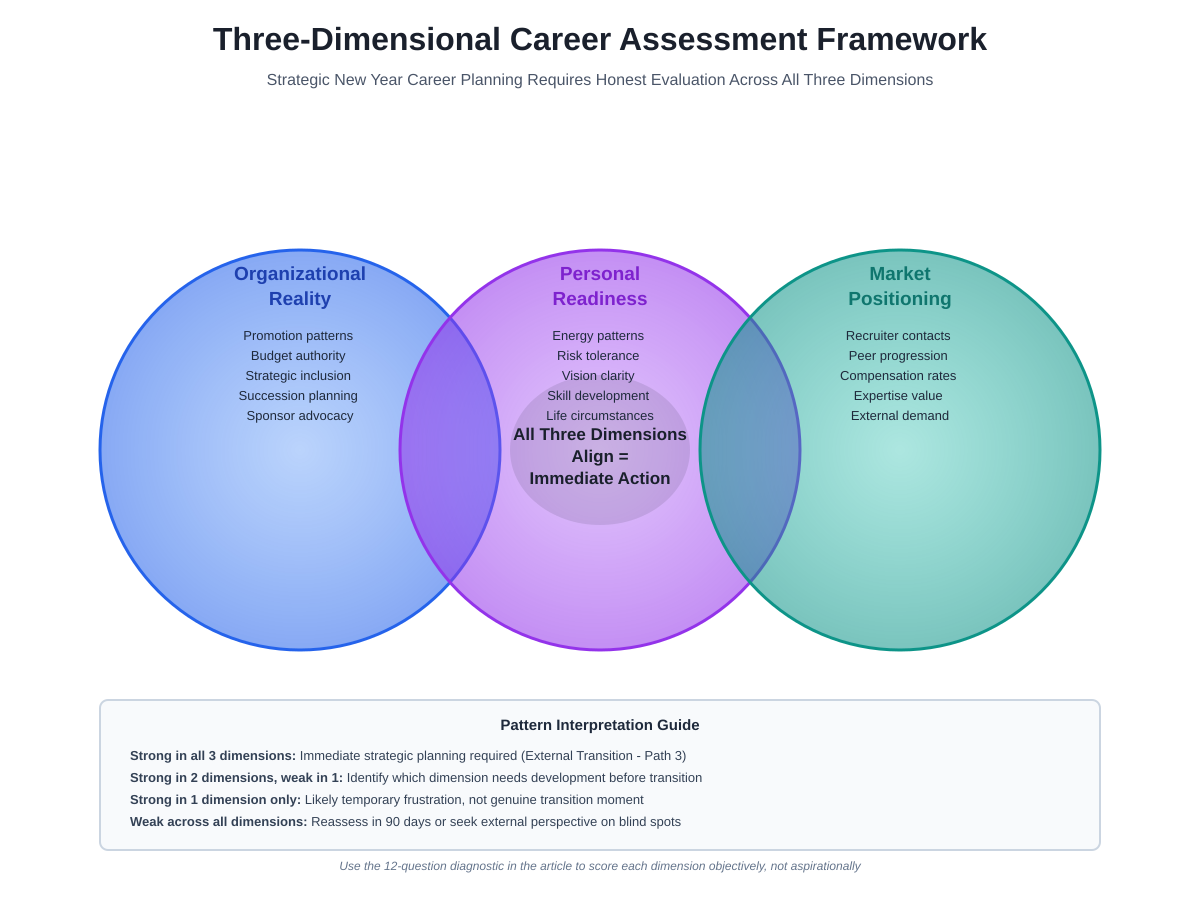
Most executives assess career opportunity through a single lens: “Are there roles I want that might be available?” This question is necessary but insufficient. It leads to decisions based on aspiration rather than evidence, hope rather than strategic reality.
Over two decades supporting executive transitions, I’ve observed that successful career planning requires simultaneous evaluation across three distinct dimensions. CIPD research on employee development and career progression confirms that multi-dimensional assessment leads to more successful transitions than single-factor evaluation.
Dimension 1: Organisational Reality
This dimension examines how your current employer actually views your future—not what they say in performance reviews, but what their actions reveal about your advancement trajectory.
Organisations rarely tell executives directly that they’ve reached their ceiling. Instead, they signal through patterns that most executives miss whilst inside the situation.
Advancement Trajectory Evidence
Look at promotions in your level range over the past 18 months. Who received them? What was their profile? How does your profile compare? If three directors were promoted to VP in your division, and your background, tenure, and performance roughly match theirs, but you weren’t promoted or even discussed as a candidate, that’s not random chance—it’s signal.
Examine your budget authority and headcount responsibility. Is it expanding, static, or contracting? Static responsibility whilst peers gain expanded portfolios indicates organisational ceiling. You’re valued for maintaining current state, not trusted with growth.
Consider strategic project involvement. Are you leading strategic initiatives, supporting them, or increasingly excluded from them? The shift from leader to supporter to observer tracks organisational perception of your strategic capability and future potential.
Pay attention to succession planning visibility. Are you explicitly mentioned in discussions about next-level roles? Do senior leaders discuss your development in concrete terms with timelines? Or has that conversation become vague and non-committal?
Sponsor Relationship Quality
Strong sponsor relationships—senior leaders who actively advocate for your advancement—are essential for executive progression. These relationships have observable characteristics: sponsors discuss specific next roles they’re positioning you for, they include you in strategic conversations beyond your direct responsibilities, they provide candid developmental feedback with concrete actions, and they spend political capital advocating for your advancement even when it’s inconvenient.
When sponsor relationships cool, you notice the shift: meetings become transactional rather than developmental, developmental conversations disappear or become generic, they stop including you in strategic planning sessions, and advocacy for your advancement becomes noticeably absent.
Most executives rationalise this shift: “She’s busy with the restructuring.” “He’s dealing with board pressure.” Sometimes those explanations are accurate. But if the pattern persists across quarters, if multiple potential sponsors have all become “too busy” simultaneously, you’re witnessing organisational signal, not temporary circumstance.
The Critical Question for Dimension 1
Set aside hope and aspiration. Based purely on observable evidence from the past 12-18 months, if nothing changes in your current organisation, where will you realistically be in December 2026?
If that answer is acceptable—genuine advancement opportunity with concrete timeline and sponsor commitment—you have viable internal path. If that answer is “roughly where I am now, perhaps with modest adjustment,” you’re witnessing plateau that requires external transition.
Dimension 2: Market Positioning
This dimension examines how the external market values your experience and expertise. Your current employer’s perception is one data point. The market provides hundreds.
Recruiter Contact Patterns
Executive recruiters are market thermometers. The level and quality of roles they approach you about reveals market perception of your positioning.
Strong market positioning shows in recruiter contacts for roles above your current level, approaches from reputable search firms (not just LinkedIn spam), and opportunities that represent genuine advancement in scope, impact, or compensation.
Plateaued market positioning shows in contacts exclusively for lateral moves, approaches primarily from contingent recruiters for roles similar to your current position, and a noticeable decline in inbound opportunities over the past 12-18 months.
Peer Progression Comparison
Identify 5-10 professionals with backgrounds similar to yours—people you knew earlier in your career, former colleagues, or industry peers you’ve observed. Where are they now compared to where you are?
If most have advanced beyond your current level, that’s market evidence that progression is achievable for your profile—which means your current plateau is organisational, not capability-based. If most remain at similar levels, you may be experiencing industry-wide career ceiling that requires strategic pivot rather than simple employer change.
This comparison isn’t about ego or competition. It’s about gathering market data that’s invisible from inside your current role.
Compensation Market Alignment
Research current market rates for your experience level and responsibilities. Use CIPD salary surveys, executive compensation databases, or confidential conversations with recruiters to establish genuine benchmarks—not aspirational figures, but realistic market rates for your profile.
If your total compensation (base plus bonus plus benefits) is 10-15%+ below market rates, that’s evidence your organisation doesn’t view you as flight risk worth retaining with competitive compensation. Organisations pay to keep people they’re worried about losing. Below-market compensation signals they’re not worried—which signals plateau.
Industry Evolution Alignment
Is your expertise growing or declining in market value? This requires brutal honesty about industry trends.
Technology executives whose expertise centers on legacy systems see declining demand regardless of their skill level. Financial services professionals whose experience is primarily in declining product categories face contracting opportunities. Energy sector executives with deep oil and gas expertise but limited renewable experience encounter similar dynamics.
Conversely, executives with experience in AI implementation, digital transformation, sustainability integration, or other high-growth domains see expanding opportunities even during economic uncertainty.
Your expertise’s market trajectory matters more than your performance in current role. Excellent execution of declining-value work still leads to career plateau.
The Critical Question for Dimension 2
If you entered the job market today, what level of roles would you realistically compete for? Be honest—not aspirational, realistic. Would those roles represent advancement over your current position, lateral movement, or potentially even step back?
If the honest answer is “advancement,” you’re potentially underutilised in current organisation. If “lateral,” you need strategic positioning development before external transition. If “step back,” you face either industry decline or skill obsolescence requiring immediate strategic response.
Dimension 3: Personal Readiness
This dimension examines your psychological and practical preparation for significant career change. The most common error executives make: confusing fantasy about change with genuine readiness for its reality.
Energy Pattern Recognition
How has your energy and engagement for work shifted over the past 12 months? Not day-to-day variation—everyone has difficult weeks. The underlying trajectory.
Genuine readiness often correlates with sustained decline in engagement that doesn’t respond to temporary boosts (holidays, interesting projects, team changes). You’re going through the motions competently but without the spark that previously characterised your work.
This isn’t burnout necessarily—you may have energy for other domains of life. It’s specifically professional disengagement that indicates you’ve extracted the growth and learning available in current context.
Conversely, if your energy remains high, if you’re still genuinely engaged by strategic challenges in your current role, you may be experiencing temporary frustration rather than genuine readiness for transition. Temporary frustration requires different response than readiness for change.
Risk Tolerance Evolution
Significant career change involves risk: financial uncertainty during transition, potential geographic relocation, learning curves in new organisations, loss of established credibility and relationships. Genuine readiness means you’ve evolved from theoretical willingness to practical acceptance of these specific risks.
Ask yourself: If offered an attractive opportunity requiring geographic relocation, would you actually move, or would you find reasons to decline? If offered a role with 15% higher compensation but less job security (smaller company, startup environment, newly created position), would you genuinely accept, or would you rationalise staying in current stability?
Many executives fantasise about change whilst their actual risk tolerance remains firmly anchored in current security. This disconnect between fantasy and readiness leads to endless career planning that never converts to action.
Vision Clarity Beyond Current Role
Can you articulate specific roles you want next? Not vague categories (“something more strategic,” “a bigger leadership role”), but concrete positions with defined responsibilities, clear success metrics, and realistic organisational contexts?
Genuine readiness includes clarity about what you’re moving toward, not just what you’re moving away from. Without target clarity, career transitions become random walks—you’ll leave current dissatisfaction only to recreate similar dynamics in new context.
Skill Development Trajectory
Are you still acquiring new capabilities, solving novel problems, developing expertise in emerging domains? Or are you primarily executing with existing skills, solving familiar problems with known approaches, and maintaining rather than building?
The shift from building to maintaining is natural career progression. But if you’re in maintenance mode whilst your aspirations require building mode, that misalignment signals readiness for context that requires growth rather than execution.
Life Circumstances Alignment
Do your personal circumstances genuinely support significant career change, or are you planning as escape fantasy from current pressures?
Family situations, financial commitments, aging parents, children’s education needs, health considerations—these aren’t obstacles to overcome through determination. They’re practical realities that either align with career transition timing or they don’t.
Proceeding with career transition when life circumstances don’t support it leads to either abandoned plans (wasting the effort invested) or forced choices that create resentment (accepting role that requires relocation when family circumstances made that unrealistic, for example).
The Critical Question for Dimension 3
Are you genuinely ready to execute career transition with its attendant uncertainties and disruptions, or are you processing current dissatisfaction through planning fantasy that feels productive without requiring actual change?
This question requires unflinching honesty. There’s no shame in recognising you’re not ready. Better to acknowledge that reality and either work toward readiness or recommit to current path intentionally than to waste months in planning that will never convert to action.
The Three-Dimension Integration
These dimensions interact to reveal your strategic reality. Examining them in isolation leads to poor decisions. The pattern across all three determines your path.
Strong signals across all three dimensions: You need immediate strategic career planning. Your organisational ceiling is real, market opportunities exist, and you’re genuinely ready to execute. Delay erodes positioning. January 2026 is your moment.
Strong Organisational Reality + Market Positioning, weak Personal Readiness: You need to change contexts, but you’re not psychologically or practically ready. This is dangerous territory—you may pursue opportunities prematurely and either decline good offers when they materialise or accept them and then struggle with buyer’s remorse. Work on readiness factors before active transition.
Strong Personal Readiness, weak Organisational Reality + Market Positioning: You’re experiencing dissatisfaction and want change, but evidence suggests either your organisation hasn’t actually plateaued you (temporary frustration, not genuine ceiling) or market doesn’t value you as highly as you assume. This pattern often leads to disappointing external searches. Requires honest recalibration of expectations or strategic skill development before transition.
Strong Market Positioning + Personal Readiness, weak Organisational Reality: Classic external transition scenario. You’re ready, market values you, but current organisation has plateaued you. This is optimal transition positioning—act on it.
The Diagnostic Assessment
Rate each statement on a scale of 1-5, where 1 = Strongly Disagree and 5 = Strongly Agree. Answer based on evidence, not aspiration.
Organisational Reality (score each 1-5):
- In the past 12 months, colleagues at my level have been promoted or significantly expanded their scope (1=multiple promotions occurred, 5=no promotions or expansions)
- I am regularly included in strategic planning discussions beyond my direct operational responsibilities (1=consistently involved in strategy, 5=excluded from strategic conversations)
- My budget authority and/or headcount responsibility has grown over the past 18 months (1=significant expansion, 5=static or contracted)
- Senior leaders discuss my development and advancement timeline in concrete, specific terms (1=regular specific discussions, 5=vague or absent conversation)
Market Positioning (score each 1-5):
- Executive recruiters contact me regularly for roles representing advancement beyond my current position (1=frequent contact for senior roles, 5=rare contact or only lateral roles)
- When I compare my progression to professionals with similar backgrounds, most have advanced beyond my current level (1=I’ve progressed similarly or better, 5=most peers have advanced further)
- My total compensation is aligned with or exceeds current market rates for my experience level (1=above market rates, 5=significantly below market)
- My core expertise is increasingly valued in market trends and industry evolution (1=growing demand for my expertise, 5=declining market relevance)
Personal Readiness (score each 1-5):
- My energy and engagement for work has remained consistent or increased over the past 12 months (1=consistently engaged, 5=significantly declined)
- I can articulate three specific roles or positions I want to pursue next with clear responsibilities and success criteria (1=crystal clear targets identified, 5=vague sense of “something different”)
- I am financially prepared for 3-6 months of career transition with current expenses covered (1=comfortable financial runway, 5=paycheck dependent with no buffer)
- My personal and family circumstances fully support geographic flexibility or significant role change if required (1=completely flexible, 5=major constraints exist)
Score Interpretation
Total Score 44-60 (High Strategic Urgency): Multiple strong signals across all three dimensions indicate genuine career plateau requiring immediate strategic action. Your market value is at or near its peak in current context—delay will erode your positioning. January 2026 career planning should begin immediately, focused on external transition (Section 3, Path 3).
Total Score 32-43 (Strategic Assessment Required): Clear patterns emerging in some dimensions. This requires deeper analysis based on where your scores concentrate:
- If questions 1-4 (Organisational Reality) total 16-20 AND questions 5-8 (Market Positioning) total 16-20, but questions 9-12 (Personal Readiness) total under 12: You face genuine career plateau but aren’t ready to execute transition. Prioritise readiness factors (financial runway, family alignment, risk tolerance) before active job search.
- If questions 9-12 (Personal Readiness) total 16-20 but other dimensions score lower: You’re experiencing dissatisfaction and desire change, but evidence suggests either temporary frustration rather than genuine plateau or market positioning weaker than assumed. Risk pursuing wrong opportunities or accepting roles that don’t advance your situation.
- If questions 1-4 (Organisational Reality) score high (16-20) but other dimensions moderate (12-15 each): You may have internal advancement opportunity if you address positioning and commit psychologically. Consider Path 1 (Strategic Internal Advancement) before external transition.
Total Score 12-31 (Monitor and Develop): Limited plateau indicators currently visible. Either you’re genuinely advancing in current context, you’re recognising very early warning signals before patterns solidify, or you’re not yet seeing reality clearly. Recommended actions: share this assessment with trusted mentor or coach for external perspective, reassess quarterly to track pattern development, focus on skill development and strategic positioning, and consider whether life circumstances are temporarily clouding career judgement.
Critical Individual Indicators
Regardless of total score, these individual scores demand immediate attention:
- Question 1 scored 5: No promotions at your level in 12 months signals organisational stagnation or contraction. External opportunities likely exceed internal ones.
- Question 4 scored 5: Absent advancement discussions indicate you’ve been implicitly plateaued even if explicitly valued. Organisation sees you in maintenance mode.
- Question 6 scored 5: Peers advancing significantly beyond you provides market evidence that progression is achievable for your profile—your plateau is organisational, not capability-based.
- Questions 9-11 combined score 13-15: Declining engagement, clear vision beyond current role, and financial readiness create psychological momentum toward change that will find outlet—better to channel it strategically than have it manifest as performance decline or impulsive decisions.
Using Your Assessment Results
Date this assessment and file it. Share it with a trusted advisor who’ll provide honest perspective rather than comfortable reassurance. Repeat quarterly if your initial scores suggest monitoring rather than immediate action.
Most importantly, use the assessment to answer the question that matters: Does January 2026 represent my strategic window for career planning, or am I processing temporary dissatisfaction through planning fantasy?
If the evidence across all three dimensions points toward genuine transition need, proceed to Section 3 to identify your specific strategic path. If the evidence suggests you’re not ready or your plateau isn’t yet definitive, that’s equally valuable information—use it to recommit to current trajectory intentionally rather than drifting in resentful maintenance mode.
The Strategic Path Decision
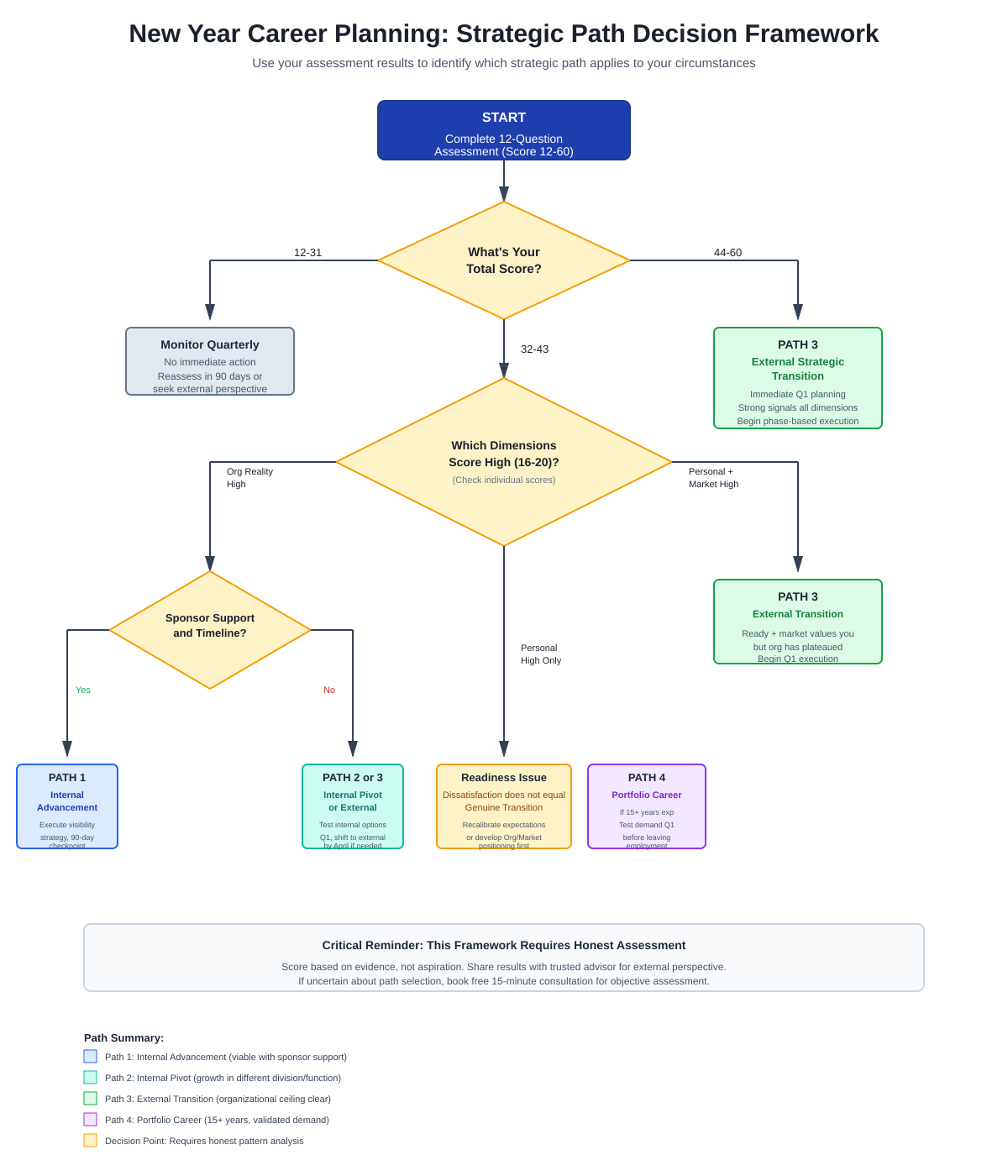
Use your three-dimensional assessment results with this decision framework to identify which of four strategic paths applies to your specific circumstances
Your three-dimensional assessment reveals whether you need career change. It doesn’t tell you which type of change serves you best. That requires understanding four distinct strategic paths, each viable under specific circumstances.
Choosing the wrong path wastes the entire Q1 window. The executive who pursues external transition when internal advancement was genuinely available damages credibility and relationships unnecessarily. The executive who invests energy in internal positioning when organisational ceiling is real wastes months that could have been spent on strategic external search.
These paths aren’t ranked by preference or prestige. They’re strategic options, each optimal under different circumstances.
Path 1: Strategic Internal Advancement
This path involves pursuing advancement within your current organisation through strategic positioning, increased visibility, and explicit advocacy.
When This Path Is Viable:
- Your Organisational Reality score is 12 or lower (meaningful advancement activity happening at your level)
- You received specific developmental feedback during performance reviews with concrete timeline (“We see you ready for VP consideration within 12-18 months pending development in X and Y areas”)
- Organisational restructuring or expansion is creating new senior roles, and you have sponsor advocating for your consideration
- Recent senior leadership changes have brought in executives who don’t know your work yet—fresh eyes create fresh opportunity
- Your plateau stems from lack of visibility to decision-makers, not actual ceiling
When This Path Is Delusional:
- You’ve been “in development for next level” for 2+ years without concrete progress
- Advancement conversations are consistently vague: “keep performing well, opportunities will come”
- Senior roles in your domain have been filled externally whilst you were supposedly being developed
- Your sponsor who advocated for you has left the organisation or been sidelined
- Budget constraints or organisational contraction make new senior positions unlikely for 12+ months
Q1 2026 Strategy for Path 1:
January: Schedule explicit advancement conversation with your manager’s manager or other decision-maker. Not your direct manager—the person who actually influences senior promotion decisions. Request specific timeline, required milestones, and concrete role expectations. If conversation yields vagueness, that’s evidence Path 1 isn’t viable—shift to Path 3 before February.
February-March: If January conversation produced concrete commitments, execute visibility strategy. Volunteer for highest-profile strategic initiative available. Present at senior leadership meetings. Publish thought leadership that positions you as strategic thinker, not just executor. Build relationships with executives outside your direct reporting line. Create situations where decision-makers observe your strategic capability, not just hear about it secondhand.
April Checkpoint: Reassess whether promises from January are materialising. Has sponsor secured you role on strategic project? Have developmental conversations continued with increasing specificity? If yes, continue Path 1 through Q2. If no—if April feels remarkably similar to January despite your positioning efforts—you’ve tested Path 1 and found it nonviable. Shift immediately to Path 3.
Common Path 1 Mistakes:
The most expensive mistake executives make: remaining on Path 1 based on hope rather than evidence. Organisations are skilled at retaining valued contributors with vague advancement promises that never materialise. “Keep performing well and we’ll see what opportunities emerge” isn’t a development plan—it’s retention strategy.
Set the April checkpoint and honour it. If concrete progress hasn’t occurred by then, you have clear evidence Path 1 isn’t viable. Acknowledge reality and shift paths rather than investing another year in false hope.
Path 2: Strategic Internal Pivot
This path involves lateral internal moves to different divisions, functions, or geographies within your current organisation, creating fresh advancement runway.
When This Path Is Viable:
- Your current division or function is contracting, but other areas of organisation are growing
- Your expertise has become too specialised—you’ve mastered a niche but that niche doesn’t ladder to senior roles
- Different geographic locations within your organisation offer advancement opportunities (UK executive willing to relocate to GCC offices, for example)
- You value your organisation’s mission, culture, or benefits enough that internal pivot is preferable to external move
- Internal mobility would genuinely create new advancement trajectory, not simply reset plateau clock
When This Path Is Self-Deception:
- Organisation-wide stagnation or contraction affects all divisions—no area is genuinely growing
- You’re considering lateral move to avoid difficult decision about external transition
- Previous internal moves haven’t created advancement—this would be your third lateral move without upward progression
- The “opportunity” in different division is similarly plateaued—you’re moving from one ceiling to another
- Organisational culture or leadership issues that frustrate you exist across all divisions
Q1 2026 Strategy for Path 2:
January: Research internal growth areas. Which divisions received 2026 budget increases? Where is organisation investing in new initiatives? Who are the rising star executives leading expanding teams? This intelligence gathering reveals where genuine opportunity exists versus organisational rhetoric.
February: Build relationships with leaders in target divisions. These aren’t applications—they’re exploratory conversations. “I’m interested in understanding the strategic priorities in your division and whether my background might add value.” Position pivot as strategic development interest, not escape from current role.
March: If genuine opportunities emerged from February conversations, negotiate transition with current manager. Handle this delicately—you need their support, not resentment. Frame as development opportunity that benefits organisation by building your cross-functional capability. If no genuine opportunities emerged, you’ve tested Path 2 and found it nonviable—shift to Path 3.
The Critical Path 2 Question:
Will this lateral move genuinely create new advancement opportunity within reasonable timeline (12-18 months), or am I simply resetting the plateau clock without changing underlying trajectory?
Be ruthlessly honest. If the lateral move puts you in similar organisational layer with similar advancement prospects, you’re delaying inevitable external transition whilst wasting political capital on internal move that doesn’t solve underlying problem.
Path 3: External Strategic Transition
This path involves pursuing advancement opportunities outside your current organisation through targeted external search.
When This Path Is Necessary:
- Organisational Reality score is 16+ (clear evidence of plateau)
- 18+ months in current role without meaningful scope expansion, budget increase, or advancement discussion
- Strategic projects, organisational restructuring, and promotion decisions consistently exclude you
- Compensation has fallen 10%+ behind market rates despite maintained performance
- Testing Paths 1 or 2 during Q1 revealed they’re nonviable
- Industry or company contraction means advancement opportunities won’t emerge regardless of your performance
When External Transition Should Wait:
- Less than 12 months in current role—tenure too brief to have tested advancement potential
- Personal circumstances genuinely don’t support job search (family crisis, health issues, financial constraints)
- Market Positioning score suggests you need skill development before you’ll be competitive externally
- You’re using external search to avoid addressing performance or relationship issues that will follow you to new context
Q1 2026 Strategy for Path 3:
This path requires most extensive preparation and execution. Section 4 provides the complete phase-based framework. In summary:
January (Weeks 1-3): Professional positioning foundation—CV transformation, LinkedIn optimisation, target role and organisation identification, compensation research, and financial transition planning.
February (Weeks 4-7): Network activation and market intelligence—reconnect strategically with former colleagues and industry contacts, schedule informational conversations with people in target roles, research decision-makers at target organisations, and begin selective signaling of availability to trusted network.
March-April (Weeks 8-14): Active search execution—targeted applications to 5-8 optimal opportunities (not 50 mediocre ones), direct outreach to hiring managers, executive recruiter engagement, interview preparation, and offer negotiation.
May-June: Transition to new role with proper notice period and relationship preservation.
Common Path 3 Mistakes:
The scattershot approach: applying to every vaguely relevant role, hoping volume creates results. This signals desperation, not strategic thinking. It also consumes enormous time customising applications without equivalent return.
The premature broadcast: announcing job search widely before professional materials are positioned properly. Your current employer often learns of your search before you’ve secured new opportunity, creating awkward final months and potential pressure to leave before you’re ready.
The negotiation failure: accepting first offer without proper evaluation or negotiation. You have maximum leverage when multiple opportunities are progressing simultaneously and you’re still employed. Use it.
Path 4: Portfolio Career Development
This path involves transitioning from single employer to portfolio of consulting, advisory, fractional executive, or interim roles.
When This Path Is Viable:
- 15+ years experience with expertise that’s genuinely monetisable as independent service
- Financial runway for 6-12 months of business development with reduced income
- Network that can generate consulting or advisory opportunities (validated through actual conversations, not assumption)
- Proven market demand—you’ve been asked to consult or advise previously
- Genuine preference for portfolio work over single employer, not just fantasy of independence
When This Path Is Romantic Delusion:
- You’re considering it primarily as escape from current frustration rather than strategic preference
- Financial pressure makes consistent income necessary—portfolio careers require runway
- Your expertise is valued within organisational contexts but doesn’t translate to independent consulting
- You haven’t validated market demand through actual client conversations or trial projects
- You’re underestimating business development effort required—securing clients will consume 40-50% of your time initially
Q1 2026 Strategy for Path 4:
January-February (Test Before Committing): Whilst still employed, test demand through side projects. Offer advisory services to startups or small companies for modest fees. If you can’t secure paying clients whilst employed (when financial pressure is minimal), you definitely can’t secure them when unemployed and financially stressed.
March-April (Build Foundation If Demand Validates): Develop service packaging and pricing, create basic website and professional positioning, establish 2-3 anchor clients who commit to ongoing relationships, and build financial model based on realistic client acquisition timeline.
May-June (Transition Only If Foundation Is Solid): If you’ve secured 2-3 paying clients and validated demand, transition from employment to portfolio career. If you haven’t secured paying clients by May, that’s evidence demand doesn’t exist at level you assumed—shift to Path 3 instead.
The Portfolio Career Reality:
Most executives romanticise independent consulting whilst underestimating its demands. You’re not just delivering expertise—you’re running a business. That means sales, marketing, contracting, invoicing, client relationship management, and all administrative overhead. The expertise delivery that excites you might consume only 40% of your time, with 60% spent on business operations.
If that division of effort appeals to you, portfolio careers are rewarding. If you want to focus purely on expertise delivery, traditional employment likely serves you better than independence.
Recognised Your Strategic Path But Uncertain About Execution?
Assessment clarifies direction. Execution requires expertise, accountability, and strategic positioning most executives can’t create alone—not due to lack of capability, but lack of objective perspective.
Take the next step:
Book a complimentary 15-minute consultation. We’ll discuss your specific situation, validate your path assessment, and determine whether you’d benefit from structured support or can execute independently.
Book Free 15-Minute Consultation →
No sales pressure. Honest assessment of whether coaching would accelerate your specific situation. Many executives execute successfully independently; some benefit from expert guidance. The consultation clarifies which applies to you.
The Phase-Based Execution Framework
Executive career transitions don’t follow rigid weekly checklists. Anyone who tells you “Week 1: update your CV, Week 2: activate your network” fundamentally misunderstands executive complexity. You’re managing current role demands, family responsibilities, geographic constraints, and strategic decision-making that can’t be compressed into formulaic timelines.
What does work: phase-based progression that provides strategic sequencing whilst acknowledging your individual pace and circumstances. Some executives complete the entire framework in 90 days. Others require 120-150 days. What matters isn’t calendar compliance—it’s moving deliberately through each phase without stalling in planning paralysis.
This framework applies primarily to Path 3 (External Strategic Transition), though elements apply to other paths as well.
Phase 1: Foundation and Assessment (2-4 weeks typical)
Most executives want to jump immediately to applications and networking. That’s precisely backwards. Strategic transitions begin with foundation that makes all subsequent effort more effective.
Core Objective
Move from vague dissatisfaction to strategic clarity. By the end of this phase, you should be able to articulate specific target roles, organisations, or industries without hedging. If you finish Phase 1 still using phrases like “something more strategic” or “a bigger leadership role,” you haven’t completed the phase—you’ve engaged in planning theater.
Critical Activities
Strategic Assessment Finalisation: If you completed the three-dimensional diagnostic in Section 2 and landed on Path 3, you’ve done the preliminary work. Now deepen it. Share your assessment with a trusted mentor or former manager who knows your capabilities but isn’t invested in keeping you in current role. Their external perspective often reveals blind spots you can’t see from inside your situation.
Financial Planning: Career transitions require financial runway. Calculate your genuine monthly expenses (not aspirational budget—actual spending). Determine how many months of runway you have if income ceases or reduces during transition. If the answer is less than 3 months, you need to build savings before active job search or accept that your search will have desperation urgency that weakens negotiating position.
Include transition costs in your planning: potential interview travel, professional wardrobe updates if needed, career coaching or CV writing services, membership in professional associations or networking groups, and possible geographic relocation costs if considering roles outside current location.
Target Role Identification: This requires moving beyond generic categories to specific roles with defined characteristics. Create a target profile: What’s the role title range you’re pursuing? (Director to VP? VP to C-suite? Specific functional leadership?) What’s the organisational context? (FTSE 250? Mid-sized private company? Startup/scale-up? Public sector? International organisation?) What’s the geographic scope? (UK only? Open to GCC? USA opportunities viable?)
Identify 5-8 specific organisations or 3-5 specific role types you’re targeting. “Five senior finance roles in healthcare technology companies” is specific. “Leadership positions in growing companies” is useless.
Compensation Research: Use CIPD salary surveys, executive compensation databases (options include Glassdoor for some roles, though executive data is limited), or confidential conversations with executive recruiters to establish realistic market rates for your target level and industry.
Determine your walk-away number—the minimum total compensation you’d accept. This isn’t your asking price; it’s your floor. If you don’t know this number before negotiation, you’ll make poor decisions under pressure.
Stakeholder Alignment: If career transition might require geographic relocation, schedule those family conversations now, not after receiving offer that requires move. If your spouse or partner isn’t genuinely prepared for relocation, pursuing roles requiring it wastes everyone’s time. If aging parents or children’s education create constraints, acknowledge them explicitly and factor into target role selection.
Common Phase 1 Derailers
Analysis paralysis: Spending 6-8 weeks perfecting your assessment instead of deciding and moving forward. Assessment should take 2-3 weeks maximum. If you’re still “gathering information” after a month, you’re avoiding the decision, not preparing for it.
Skipping financial planning: Many executives skip this step and then make desperate decisions when opportunity appears but financial pressure demands immediate income. Do the mathematics now while you’re employed and thinking clearly.
Avoiding difficult conversations: Not discussing geographic flexibility with spouse until you have offer requiring relocation. Not addressing care responsibilities for aging parents until they become crisis during your interview process. Have these conversations before they become urgent.
Phase 1 Complete When…
You can sit down with trusted advisor and articulate: “I’m pursuing [specific role type] at [specific organisation type or list of target companies]. My floor compensation is [specific number] and my target is [realistic market rate for these roles]. My timeline is [realistic completion target]. My constraints are [honest assessment of geographic, timing, or other limitations].”
If you can’t articulate this clearly and specifically, you’re not ready for Phase 2. Return to assessment and target definition until you achieve clarity.
Phase 2: Positioning and Intelligence (3-4 weeks typical)
Core Objective
Professional materials position you credibly for target roles. Market intelligence reveals which opportunities align with your criteria and how to access decision-makers. Your network understands you’re strategically exploring options without broadcasting desperate availability.
Critical Activities
CV Transformation (Not Update): Most executives approach their CV as document requiring update—add recent accomplishments, adjust dates, minor formatting. That’s insufficient for strategic transition.
Your CV requires transformation: repositioning from your current role toward your target roles. This means emphasising transferable strategic capabilities over tactical execution, quantifying impact in ways that translate across industries or functions, and positioning your trajectory as natural progression toward target level.
For complex CV transformation, many executives benefit from professional CV writing services or career coaching. The investment (typically £200-500 for executive CV writing, or part of comprehensive coaching programme) is minimal compared to compensation impact of strong positioning.
LinkedIn Optimisation: Your LinkedIn profile isn’t your CV in different format. It’s your professional brand, your networking tool, and increasingly your first impression with recruiters and hiring managers.
Headline should position you for target roles, not merely describe current position. “Finance Director | Healthcare Technology | Strategic Planning & Digital Transformation” is stronger than “Finance Director at Company X.” Your About section should read like strategic overview of your value proposition, not job history. Experience descriptions should emphasise leadership impact and strategic contributions over task completion.
Executive Narrative Development: Prepare your story: Why this career move? Why now? Why you for these target roles? This narrative gets tested in networking conversations, recruiter calls, and interviews. Developing it now—whilst thinking strategically, not whilst sitting in unexpected recruiter call—ensures consistency and confidence.
The narrative should flow logically: your expertise progression, what you’ve accomplished, what you’re seeking next, and why your background positions you excellently for it. Avoid defensive or apologetic tone about wanting to leave current role. Frame as strategic next chapter, not escape from current frustration.
Market Intelligence Gathering: Research your target organisations or industries systematically. For specific target companies: Who are the key decision-makers in your target functions? What strategic initiatives did they announce in recent quarters? What challenges are they facing that your expertise addresses? Who in your network has connections there?
For industry or role type targets: Which companies are growing in this space? What’s the typical career path to these roles? Which executive recruiters specialise in these placements?
This intelligence transforms generic applications into strategic approaches that demonstrate you’ve done your homework.
Network Activation (Not Job Begging): Reactivate dormant professional relationships, but not by asking for jobs. That’s amateur approach that makes people uncomfortable and yields poor results.
Instead, reach out for intelligence and advice: “I’m exploring strategic moves into [target area]. Given your experience in that space, I’d value 20 minutes to understand the landscape and whether my background might be relevant. Would you have time for a brief call?”
These conversations provide market intelligence, surface hidden opportunities, and position you in people’s awareness without desperate “do you know of any jobs?” approach.
Attend 2-3 industry events or join relevant professional groups during this phase. LinkedIn groups, CIPD events, industry conferences—whatever provides access to your target domain. The goal isn’t immediate job leads; it’s building visibility and relationships.
If Path 1 (Internal Advancement) Applies
Your Phase 2 looks different: schedule that explicit development conversation with decision-maker (outlined in Path 1 section), identify highest-visibility strategic initiatives where you can demonstrate capability beyond current role, build relationships with senior stakeholders outside your reporting line, and document achievements in ways that position you for advancement discussions.
Common Phase 2 Derailers
Perfectionism on CV: Endless tweaking and refinement instead of completing and moving forward. Your CV should be strong, professional, and effective—not perfect. Diminishing returns set in quickly. After 6-8 hours of focused work (or professional service completion), ship it and move to active use.
Networking as job solicitation: Contacting everyone you know with “I’m looking for new opportunities, let me know if you hear of anything.” This approach generates polite responses and zero results. People don’t know how to help you when you’re vague, and they’re uncomfortable with direct job requests from casual contacts.
Broadcasting availability too widely too early: Before professional materials are positioned, before you have clarity on targets, before you’re ready for serious conversations—telling everyone you’re job searching. This often reaches your current employer before you’ve secured new opportunity, creating awkward final months and potential pressure to leave prematurely.
Skipping compensation research: Entering negotiation without understanding market rates. You either ask for too little (leaving money on table) or too much (pricing yourself out of consideration). Research now while you’re thinking strategically.
Phase 2 Complete When…
Professional materials position you credibly for target roles—you’d be comfortable sending your CV to any of your target opportunities right now. You’ve gathered intelligence on 10-15 specific opportunities or organisations. You’ve had 5+ informational conversations that provided market insight and positioned you in people’s awareness. You have clear understanding of compensation benchmarks for your targets.
If you can’t ship your CV without cringing, if you haven’t had actual conversations with people in or adjacent to target roles, if you don’t know realistic compensation ranges—Phase 2 isn’t complete.
Phase 3: Strategic Execution (4-6 weeks typical)
Core Objective
Convert preparation into active opportunities through targeted applications, strategic networking, recruiter engagement, and interview excellence.
Critical Activities
Targeted Applications (Quality Over Volume): This is where most executive searches fail. The scattershot approach—applying to 40-50 roles hoping something sticks—signals desperation and wastes enormous time.
Strategic approach: identify 5-8 optimal opportunities that genuinely align with your criteria. For each, invest time in proper application: research the specific organisation and role deeply, customise your CV to emphasise most relevant experience, write cover letter that demonstrates you’ve done your homework (not generic template), and identify how to reach hiring manager or decision-maker directly when possible.
Five strategically targeted applications with hiring manager outreach generate better results than 50 generic applications through HR portals.
Direct Hiring Manager Outreach: For your top-priority targets, don’t rely solely on application portals. Use LinkedIn, mutual connections, or direct email to reach the actual hiring manager: “I’ve applied for [specific role]. Given my background in [relevant experience], I believe I could add significant value to [specific strategic initiative you’ve researched]. Would you have 15 minutes to discuss whether my profile aligns with what you’re seeking?”
This approach doesn’t always work. Many organisations require HR process compliance. But when it works, you’ve bypassed competition entirely.
Executive Recruiter Engagement: For senior roles, executive search firms control many opportunities. But approaching recruiters requires strategy.
Research which search firms specialise in your target industry, function, or level. Firms have specific practice areas—don’t contact generalist recruiters for specialised roles. Reach out with your executive summary and target role clarity: “I’m exploring Chief Financial Officer opportunities in healthcare technology. Your firm’s track record in this space suggests we should connect. Would you have time for brief introduction call?”
Recruiters respond to clarity and realistic self-assessment. If you’re Director level presenting yourself for C-suite roles, they’ll ignore you. If you’re realistic about level and clear about targets, they’re valuable partners.
Interview Preparation: For each active opportunity, invest in specific preparation beyond generic interview coaching.
Research the organisation’s strategic priorities, recent challenges, leadership team, and competitive position. Prepare 10-12 STAR method achievement scenarios that demonstrate capabilities the role requires. Practice articulating strategic thinking, not just execution excellence—senior roles require strategic demonstration. Prepare thoughtful questions that reveal genuine interest in their specific challenges, not generic “what’s the culture like?”
Managing Current Role Whilst Searching: This is delicate balancing act. You need to maintain strong performance (references will matter), avoid raising suspicions prematurely, and create time for interview preparation and attendance.
Schedule interviews as “medical appointments” or “personal commitments” when possible. Don’t let performance slip noticeably—that raises questions. Don’t confide in current colleagues until you have signed offer. Even trusted colleagues can inadvertently share information that reaches management.
If Path 1 (Internal Advancement) Applies
Your Phase 3: execute the visibility strategy from Phase 2, deliver exceptional results on that high-profile project you volunteered for, schedule your 90-day review of the advancement commitment from January, and prepare to shift to Path 3 if internal progress isn’t materialising.
Common Phase 3 Derailers
The desperation application spray: Applying to everything remotely relevant because “more applications mean more chances.” This consumes enormous time with minimal return and signals lack of strategic thinking.
Weak interview preparation: Assuming your experience speaks for itself, so you’ll “just be yourself” in interviews. Senior roles require demonstrating strategic capability. “Being yourself” without preparation rarely showcases your best strategic thinking.
Accepting first offer without evaluation or negotiation: When offer appears after weeks of searching, relief and fear of losing it override strategic evaluation. You accept without proper compensation analysis or negotiation. This costs tens of thousands of pounds over the life of the role.
Burning bridges through obvious disengagement: Once you’re actively interviewing, engagement with current role often plummets. This is visible to colleagues and managers, creates awkward final months, and potentially damages references you’ll need.
Phase 3 Complete When…
You have 2-3 active opportunities progressing through interview stages, or you’ve completed interview processes and are evaluating offers. You’ve maintained strong performance in current role without raising premature suspicions. You’ve prepared references who’ll speak credibly to your capabilities. You have clear compensation parameters and negotiation strategy.
Phase 4: Negotiation and Transition (2-3 weeks typical)
Core Objective
Secure optimal offer terms and transition professionally from current role whilst preserving relationships.
Critical Activities
Offer Evaluation: Evaluate total compensation, not just base salary: base salary, bonus structure (guaranteed vs performance-based), equity or profit sharing if applicable, benefits (pension, health insurance, car allowance), holiday entitlement, flexible working arrangements, and relocation support if relevant.
Compare offer against your walk-away number from Phase 1 and realistic market rate from your research. If offer meets your floor and approaches market rate, you’re in viable territory. If it’s significantly below either, you need to negotiate or decline.
Multi-Offer Leverage: Ideal scenario: multiple opportunities progressing simultaneously, creating natural negotiating leverage. “I’m very interested in your opportunity. I’m also in final stages with another organization. Can we expedite timeline to offer?” This creates urgency and demonstrates your market value.
Even without competing offers, you can negotiate professionally: “I’m excited about this opportunity. Based on my research of market rates for this level and responsibilities, I was expecting compensation in the [realistic range] area. Is there flexibility to reach that level?”
Professional Resignation: Once you’ve accepted offer, resign from current role professionally. Provide proper notice (typically 4 weeks minimum for senior roles, often longer). Offer to transition your responsibilities comprehensively. Don’t express grievances or burn bridges—maintain professionalism regardless of circumstances prompting your departure.
Your resignation letter should be brief and professional: express appreciation for opportunities provided, announce resignation effective [date], and offer to support smooth transition. That’s all.
Relationship Preservation: Your current colleagues and managers are part of your long-term professional network. Departing professionally preserves those relationships for future benefit: they might hire you as consultant, they might move to organisations where you’ll want to work later, or they might be positioned to provide valuable introductions or references.
Burning bridges feels satisfying momentarily and costs you professionally for years.
The 90-Day Reality Check
From decision to new role start, realistic executive transitions typically require 16-20 weeks (4-5 months). This breaks down roughly: 2-3 weeks for Phase 1, 3-4 weeks for Phase 2, 6-8 weeks for Phase 3, 2-3 weeks for Phase 4, and 4+ weeks notice period.
Start in early January: new role begins in May-June.
Start in April: new role begins in August-September.
That’s the strategic timing difference. January start means you’re established in new role for Q2 and Q3, building credibility and impact ahead of year-end performance cycles. April start means you’re beginning in Q3, with minimal time to establish impact before year-end reviews.
These aren’t rigid timelines—some transitions happen faster, some slower. But the pattern holds: early start creates entire additional performance cycle to establish yourself.
When January Planning Fails—The Recovery Framework
Not every January career plan executes successfully. Markets shift. Personal circumstances change. Organisations make unexpected decisions. The assessment that felt clear in January becomes muddled by February. You’re not alone in this—it’s common pattern I observe annually.
The difference between executives who recover from stalled plans and those who waste the entire year: recognition of failure patterns and decisive course correction rather than prolonged hope that things will somehow improve.
Common Failure Pattern 1: Analysis Paralysis
What It Looks Like: You spent January and February completing the assessment, researching opportunities, perfecting your CV, and gathering market intelligence. Now it’s March, and you’re still in preparation mode. You haven’t sent a single application, scheduled any networking conversations, or contacted recruiters. You’re still “getting ready to begin.”
Why It Happens: Fear of making wrong choice creates endless information gathering and preparation. As long as you’re preparing, you’re making progress without facing the vulnerability of actual job search. Preparation feels productive whilst avoiding risk of rejection.
Recovery Strategy: Acknowledge that preparation has become avoidance. Set hard deadline: by end of this week, you will complete one concrete action—send one targeted application, schedule one networking call, contact one executive recruiter. Not “soon.” This week.
Lower your standards for “ready.” Your CV doesn’t need to be perfect; it needs to be good enough to represent you credibly. Your target list doesn’t need to be exhaustive; it needs to include 5-8 specific opportunities you can pursue now. Ship your materials and learn from market response rather than endlessly refining in isolation.
If you cannot force yourself into action by end of March, you’ve discovered something valuable: you’re not genuinely ready for transition. That’s not failure—it’s self-knowledge. Either commit to staying in current role intentionally rather than resentfully, or engage professional coaching to work through the resistance preventing action.
Common Failure Pattern 2: The Internal Advancement Illusion
What It Looks Like: You chose Path 1, had the advancement conversation in January, received encouraging but non-specific feedback. You’ve executed visibility strategy through February and March. Now it’s April, and nothing has materially changed. No concrete next steps, no role clarity, no sponsor securing you strategic project involvement, just continued “you’re doing great, keep at it.”
Why It Happens: Organisations are skilled at retaining valued contributors through encouragement that doesn’t commit to actual advancement. Your manager and senior leaders genuinely appreciate your contributions—in your current role. They’re not being malicious when they encourage you without concrete advancement; they’re managing their needs, which include keeping you productive where you are.
Recovery Strategy: This isn’t failure—it’s evidence. You now know, based on four months of testing rather than speculation, that Path 1 isn’t viable in your current context. You haven’t wasted time; you’ve gained clarity.
Immediately shift to Path 3. Don’t spend another three months hoping internal situation changes. In April, begin Phase 1 of the external transition framework. Yes, you’ve “lost” the Q1 advantage, but April start still positions you better than June or September start.
The expensive mistake: continuing Path 1 through June, July, August based on continued encouraging-but-non-specific feedback, then starting external search in September when frustration finally overrides hope. That’s full year lost.
Cut your losses. Acknowledge Path 1 didn’t work. Redirect to Path 3 whilst you still have most of Q2 available.
Common Failure Pattern 3: Scattered Execution Without Strategy
What It Looks Like: You applied to 40+ roles through February and March. You attended several networking events. You contacted recruiters. You’ve been busy with career search activity. But it’s April, and you have zero meaningful progress: no interviews scheduled, no real conversations with hiring managers, no active opportunities progressing. Just applications disappearing into void and generic “we’ll keep your CV on file” responses from recruiters.
Why It Happens: Activity feels like progress. Each application submitted creates sense of advancement. But volume without strategy generates noise, not signal. Recruiters ignore non-specific outreach. Applications through portals get filtered by ATS systems or junior recruiters who don’t understand your strategic value. Networking without clear ask yields polite conversations that lead nowhere.
Recovery Strategy: Stop the spray-and-pray immediately. Return to Phase 1 and 2 fundamentals with ruthless focus.
From your 40 applications, identify your top 3 opportunities—the ones you’re genuinely most excited about, that best match your criteria, where you’d actually accept offer if extended. For those three only: research extensively (leadership team, strategic priorities, recent challenges, connections who know the organisation), develop customised positioning explaining specifically why you’re excellent fit for their specific needs, identify hiring manager or decision-maker and reach them directly, and prepare as though interview is guaranteed.
Three strategically targeted opportunities with deep preparation outperform 40 scattered applications with generic materials.
If this focused approach doesn’t generate interviews by late April, you have different problem: either your materials aren’t positioning you credibly (return to CV and LinkedIn optimisation, possibly with professional help), your target roles are misaligned with your actual market value (requires honest recalibration), or market conditions in your target domain are genuinely difficult (might require broadening targets or accepting longer timeline).
Common Failure Pattern 4: Life Interrupted
What It Looks Like: You began career planning in January with genuine commitment. Then family emergency occurred—aging parent health crisis, unexpected childcare responsibilities, your own health issue, major work crisis that consumed all discretionary time and energy. Now it’s March or April, and you’ve made minimal progress because life legitimately intervened.
Why It Happens: Life doesn’t coordinate with career planning timelines. Unexpected events disrupt even well-structured plans. This isn’t failure of commitment or strategy—it’s reality of adult life with complex responsibilities.
Recovery Strategy: First, distinguish genuine life interruption from excuse-making. If you were hospitalized, caring for seriously ill family member, or managing genuine crisis—that’s legitimate interruption requiring adjusted timeline. If you were “too busy with work” or “dealing with normal family responsibilities”—that’s avoidance disguised as circumstance. Be honest with yourself about which applies.
If genuine interruption: assess whether circumstances have genuinely resolved or whether you’re still in crisis management mode. If still managing crisis, accept that serious career transition isn’t viable right now. That’s not failure—it’s realistic prioritisation. Set a realistic restart date (perhaps Q3 2026 for Q4/Q1 2027 hiring cycle) and commit to it when circumstances genuinely permit focus.
If circumstances have resolved: you’re essentially starting fresh in April. Follow the full four-phase framework, accepting you’re now in Q2 hiring cycle rather than Q1. This means smaller opportunity pool and later-year landing, but it’s infinitely better than further delay.
The Quarterly Decision Point
If January planning didn’t execute for whatever reason, you face decision in April:
Option A: Q2 Relaunch — Accept you’re now competing in smaller Q2 hiring window. Adjust expectations accordingly. Focus on roles that typically hire Q2: project-based positions, backfills for unexpected departures, or organisations with non-standard fiscal years. Execute full framework April-June, targeting July-August start.
Option B: Strategic Pause Until September — If circumstances genuinely prevent effective execution until after summer, intentional pause beats half-hearted effort. Use April-August for thorough preparation. Build financial runway. Develop skills or credentials you identified as gaps. Launch strategically in September for Q4/Q1 2027 hiring cycle. This feels like delay, but strategic Q3 launch outperforms scattered Q2 effort.
Option C: Recommit to Current Trajectory — Perhaps the planning process revealed you’re not actually ready for transition. Maybe the assessment showed current role still offers development opportunity you’d overlooked. Possibly life circumstances genuinely don’t support change right now. That’s valuable discovery, not failure. Recommit to current path with renewed intention and clarity, not resentment.
The Critical Honesty Question
When career planning stalls, ask yourself: “Am I genuinely unable to execute right now due to circumstances beyond my control, or am I avoiding difficult decisions through delay I’m labeling as circumstances?”
The answer determines recovery strategy. Genuine inability requires adjusted timeline or recommitment to current path. Avoidance requires forcing action through accountability (often meaning professional coaching or structured programme that creates external commitment).
Both are valid. But confusing one for the other leads to wasted years.
The Geographic Intelligence Factor
Career planning timelines aren’t universal. They’re market-specific in ways most executives miss until timing costs them opportunities.
A UK executive applying US market timing misses the April tax year dynamic. A GCC-based executive planning UK return without understanding pre-April hiring surge loses months. Understanding these geographic nuances isn’t about being comprehensive—it’s about not sabotaging your transition through timing ignorance.
UK Market Q1 Dynamics
The April Tax Year Driver
The UK tax year ends 5 April. This creates unique hiring and mobility dynamics that don’t exist in calendar-year markets.
Many UK professionals time career moves around this date for tax efficiency. Organisations know this pattern and structure hiring accordingly. Offers frequently include April start dates to align with clean tax year beginning. Resignation spikes occur in March as people complete bonus earning periods through tax year end then transition.
Strategic implication: interview processes initiated in January often target March offers with April starts. If you delay career planning until March, you’re missing the entire Q1 cycle designed around April transition timing.
The Post-Bonus Resignation Wave
UK organisations typically pay annual bonuses February-March. HR and hiring managers know resignation wave follows immediately after bonus payment. Smart organisations accelerate Q1 recruitment before bonus season triggers departures.
For you as job seeker: January-February applications often proceed faster than March-April applications because hiring managers are motivated to secure candidates before their own staff depart. March-April applications sometimes stall as organisations deal with unexpected resignation management.
GCC Market Q1 Dynamics
Vision 2030 Hiring Cycles
Saudi Arabia’s Vision 2030, UAE’s economic diversification strategies, and broader GCC transformation initiatives create hiring patterns aligned with government milestone timelines rather than traditional calendar quarters.
Q1 2026 marks critical progress checkpoints for multiple Vision 2030 initiatives. Organisations in Saudi Arabia particularly—but across GCC markets generally—accelerate recruitment in Q1 to demonstrate progress on strategic government-aligned initiatives. This creates expanded opportunity window for international executives with relevant expertise (digital transformation, sustainability, healthcare modernisation, education development, tourism infrastructure).
Ramadan Timing Impact
Ramadan 2026 occurs approximately late February through late March (exact dates depend on lunar calendar). Across GCC markets, hiring activity measurably slows during Ramadan. Organisations remain operational, but decision-making timelines extend, interview scheduling becomes more complex, and general business pace slows.
Strategic implication: position yourself pre-Ramadan (January-early February) for offer discussions post-Ramadan (April-May). Applications submitted mid-Ramadan often stall until after Eid, creating 4-6 week delay that could have been avoided through earlier timing.
Contract Renewal Patterns and Nationalisation
Many international executive contracts in GCC markets renew based on calendar year or fiscal year cycles. Organisations make renewal decisions Q1 for mid-year expirations.
Simultaneously, Emiratisation (UAE), Saudisation (Saudi Arabia), and parallel nationalisation initiatives across GCC markets create pressure to replace international executives with national talent at certain levels. If your contract expires mid-2026, your organisation may already be recruiting your national replacement in Q1.
For international executives in GCC: don’t wait until contract non-renewal notification to begin career planning. If your contract expires in 2026, January is when you should be testing market options—both within GCC for different opportunities and potentially for home market return.
UK to GCC Transition Planning
If you’re UK-based executive considering GCC opportunity, Q1 timing creates specific advantages.
GCC organisations hiring internationally need 2-4 months for visa processing, family arrangements, housing coordination, and onboarding preparation. January applications position you for June-September starts. This timing aligns optimally with:
- Family relocation during summer school holidays
- Housing market availability (many expat families relocate summer, creating rental availability)
- Avoiding mid-academic-year school transitions for children
- Missing the intense summer heat (July-August) that makes initial adjustment more challenging
March-April applications push your start to August-October, creating school-year disruption for families and arriving during intense heat season.
GCC to UK Return Planning
International executives in GCC markets planning UK return face different timing considerations.
Use January-March to test UK market receptivity whilst still employed in GCC. Applications and interview processes can often proceed remotely through video interviews for initial stages, with final-stage interviews requiring UK travel you can coordinate around GCC commitments.
This de-risks your return: you validate UK market interest before making irreversible decision to leave GCC role. Many executives make expensive mistake of resigning GCC position based on assumption they’ll be attractive to UK market, only to discover their GCC experience doesn’t translate as effectively as expected.
Critical financial consideration: understand compensation adjustment expectations. GCC packages typically include tax-free salary, housing allowance, education allowances, and other benefits that inflate total compensation significantly above UK market rates for equivalent roles. A £120,000 GCC package might translate to £75,000-85,000 UK equivalent once you account for tax and lost benefits. Research realistic UK market rates for your level before making return decision based on GCC compensation expectations.
For comprehensive GCC career planning including Vision 2030 opportunities and nationalisation policy navigation, see: Navigate Changing Career in Saudi Arabia
Converting January Assessment Into Strategic Reality
You’ve completed the three-dimensional assessment. You understand why Q1 2026 creates strategic timing advantage. You’ve identified which of four paths applies to your circumstances. You have the phase-based execution framework.
The question now isn’t whether you’re capable of executing independently—you clearly are, or you wouldn’t have reached executive level. The question is whether expert guidance would compress your timeline and strengthen your positioning in ways that justify the investment.
Over 20 years supporting executive transitions, I’ve observed consistent pattern: executives who engage strategic coaching in Q1 secure roles 4-6 months faster than those who figure it out themselves. Not because they lack capability, but because expertise compresses learning curves, provides objective perspective they can’t achieve from inside their situation, and creates accountability that prevents common stalling patterns.
Some executives genuinely benefit from independent execution. Others benefit from structured support. The 15-minute consultation clarifies which applies to you—without sales pressure, just honest assessment of whether coaching would accelerate your specific situation.
Two Ways I Support Executive Transitions
Option 1: Job Search Bootcamp—£899
Comprehensive 6-week programme providing:
- Strategic career path validation and target role identification
- Professional document transformation (CV, cover letters, LinkedIn optimisation)
- Interview preparation with mock interviews and detailed feedback
- Salary negotiation framework and specific strategies
- Weekly accountability ensuring execution, not endless planning
Option 2: Strategic Coaching Sessions—£150/hour
Focused coaching for specific challenges:
- Assessment validation and strategic path selection
- CV and LinkedIn profile review and optimisation
- Interview preparation for specific opportunities
- Salary negotiation strategy for active offers
- GCC ↔ UK transition planning and timing guidance
Not Sure Which Approach Fits Your Situation?
Book a complimentary 15-minute consultation. We’ll discuss your assessment results, explore your timeline and goals, and determine the right support level—including whether you’d benefit from structured coaching or can execute effectively independently.
The executives who transition most successfully aren’t those with the most impressive credentials. They’re those who recognize when expert guidance compresses timelines and strengthens positioning—then act on that recognition strategically.
Your January Strategic Window
Sarah and James, the executives from this article’s opening, had equivalent credentials, similar experience, and access to the same opportunities. The difference in their outcomes—Sarah’s 28% increase and strategic role versus James’s lateral move after nine months of searching—came down to timing and strategic execution.
Sarah understood that career transitions don’t succeed on motivation or aspiration. They succeed on alignment with organisational mechanics: budget cycles, hiring timelines, and market dynamics that create strategic windows. She acted when that window opened in January. James waited for “better timing” that never arrived, competing from progressively weaker position as months passed.
If you’re reading this in late December 2025 or January 2026, you’re standing at exactly that strategic window. The Q1 hiring budget approvals are complete. The best roles will be posted in the next 4-6 weeks. Your performance review has provided clarity about internal trajectory. Bonus payments are creating financial runway. Market competition is at annual low point as other executives convince themselves to wait.
The question isn’t whether change is comfortable or whether timing is perfect. Timing is never perfect. Life circumstances are never ideal. The question is whether delaying another quarter, another year, serves your long-term career interests—or whether strategic action now, while advantage exists, creates outcomes unavailable through delay.
Your three-dimensional assessment provides the answer. If evidence across organisational reality, market positioning, and personal readiness points toward transition need, January 2026 is your moment. If evidence suggests current trajectory serves you well, that’s equally valuable—recommit intentionally rather than drift in resentment.
Either way, you now have framework for honest assessment and strategic action. The executives who build most successful careers aren’t those who never face crossroads. They’re those who recognise them clearly and act decisively.
Your strategic window is open. How you use it determines your 2026—and potentially your next decade.
Continue Your Strategic Career Planning Journey
Coming in this series:
- Article 2: “Promotion or Pivot: Your New Year Career Decision Framework”
- Article 3: “Executive Job Search Strategy: The Q1 Market Advantage”
Related resources: