

In short: UK pay transparency rules will require employers to publish pay in job adverts, or in writing before interview. For directors, the published figure will usually be base salary only. Bonus, long-term incentives and buy-outs sit outside it, and employers can still ask your current salary, which decides where in the range your offer lands.
On 5 November 2026, Prime Minister Andy Burnham confirmed that the government will make it a legal requirement for employers to publish salaries in job adverts, and asked businesses to start now. The announcement followed the consultation that closed on 27 October, in which 94% of respondents favoured greater pay transparency, and the 28 October Budget, in which Chancellor John Healey said the government would act soon. There is still no start date, and the government has not said what counts as pay beyond basic salary.Directors have the most to gain on paper. HR DataHub’s analysis of 2.8 million UK job adverts, reported in December 2025, found that only 39% of employers published director pay ranges, against 67% for frontline roles. Director adverts will change more than any others. From the hiring side, though, the figure that goes on the advert was always the part of a director offer that took the least negotiating.
Directors in Riyadh or Dubai weighing a UK role will recognise the gap. Saudi rules already require job adverts to describe the job and its benefits while stopping short of a pay figure, according to Lewis Silkin’s July 2026 review, and a Gulf package is typically assembled from basic salary plus housing, transport and school fees allowances and medical cover that a base figure on its own never shows. The same discipline applies to international executives weighing a move to Saudi Arabia: compare packages, never headline numbers.
What will UK pay transparency law actually show a director?
Most likely a base salary range and very little else. The comparable regimes in the US and Canada centre the posting duty on base pay, and the UK consultation has left the definition of pay beyond basic salary to later regulations.
A number of US state laws require a salary range and stop there. Washington goes furthest: employers must add a general description of bonuses, stock and other compensation, and the state’s own example of compliant wording is a single sentence saying the hire can buy company stock, receive annual bonuses and join profit-sharing. California widened its definition of wages from January 2026 under SB 642 to include bonuses and equity, but that change applies to equal pay claims. The California job posting duty is still a good-faith estimate of the salary range on hire.
Ontario is the most instructive precedent for directors. Since 1 January 2026, employers with 25 or more staff must publish pay in public job postings, with ranges capped at a C$50,000 spread, yet roles expected to pay more than C$200,000 a year are exempt entirely. The more senior the role, the less pay transparency reaches it.
Why is the published range the smaller part of a director offer?
Base salary is one of several components an employer prices when it hires a director, and it is the only one pay transparency rules are likely to reach. Annual bonus targets, long-term incentive awards and buy-outs of awards the candidate forfeits by resigning are usually agreed with reward or the remuneration committee once a preferred candidate exists.
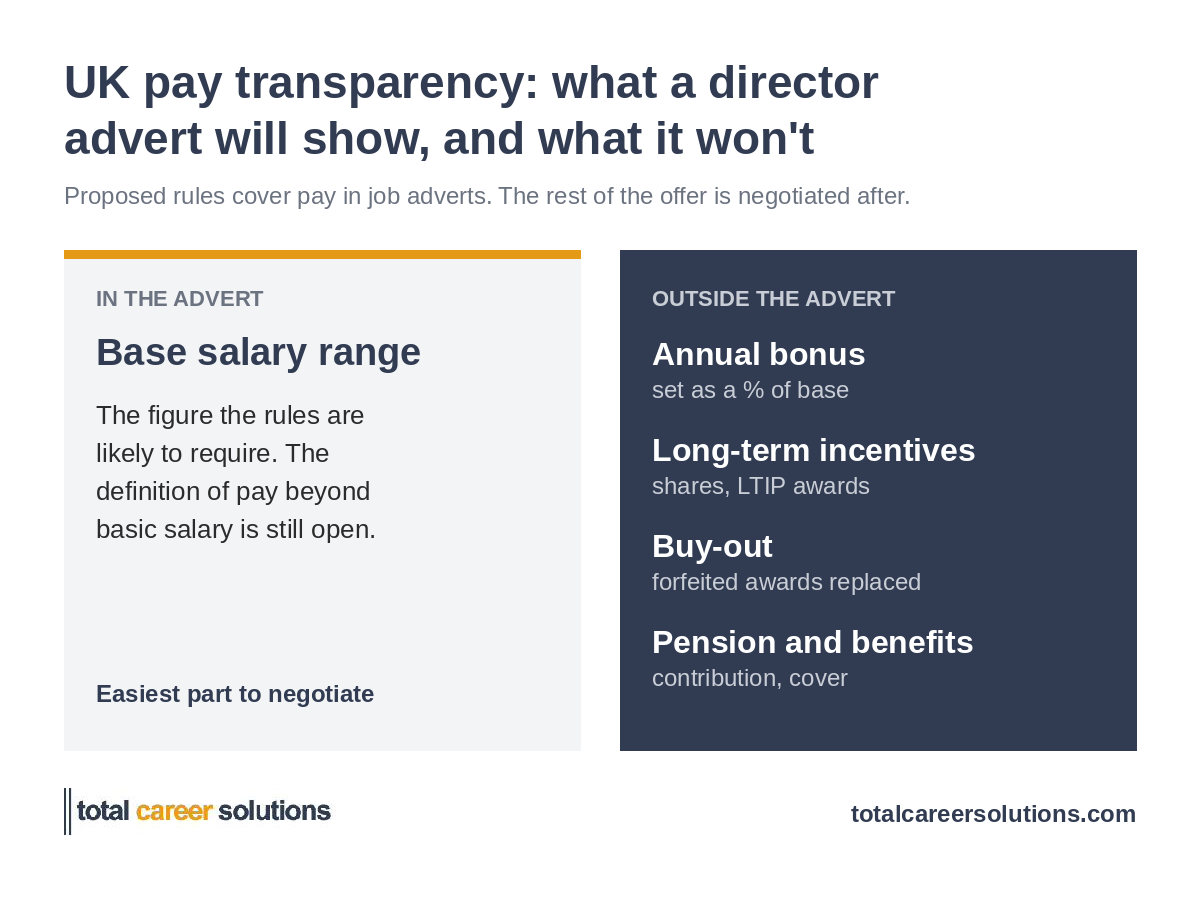 In twenty years on the hiring side, the buy-out was where director offers were won or lost. A candidate leaving with two years of unvested shares and a bonus due in March is walking away from real money, and the new employer has to decide how much of it to replace and from which budget. None of that appears in a published range, and none of it will under the UK proposals as drafted.
Variable pay matters for a second reason. Director bonus targets are usually expressed as a percentage of base, so the base figure agreed at offer stage sets the size of every bonus that follows. The same approval chain then governs your pay once you are in post, which is why how directors get pay rises approved starts with the number you accept on day one.
Where in the published range will you land?
Placement in the range is usually decided by two figures: what comparable incumbents earn and what you earn today. The UK consultation does not propose stopping employers asking for the second.
The EU went further. Article 5 of the Pay Transparency Directive requires employers to give candidates pay information before interview and bars them from asking about pay history, although only five of the 27 member states had fully transposed it by September 2026. The Equality and Human Rights Commission’s response to the UK consultation, published on 27 October 2026, recommended a ban on asking candidates about salary history or salary expectations. Until the government says otherwise, UK pay transparency will sit alongside the current-salary question.
From the hiring side, the current-salary answer does more to fix the offer than the published band. Take a £130,000 to £160,000 range and a candidate on £140,000: the offer gravitates towards £150,000, because a modest uplift on current pay is easy to justify to whoever signs off the offer, and a jump to the top of the band needs an argument. The range tells you the ceiling. Your answer to the current-salary question decides how close to it you get, which is why how you answer the salary expectations question matters more under pay transparency, and why what panels weigh in executive salary negotiation still applies once the range is public.
Negotiating a director offer in 2026?
Get a hiring-side view of where your number should sit before the current-salary question comes up.
Does pay transparency push director salaries up?
The strongest evidence says publishing pay lifts wages modestly, though it says little about director roles specifically. A National Bureau of Economic Research working paper by David Arnold, Simon Quach and Bledi Taska, published in November 2025, found that state posting laws raised the share of job postings with salary information by 30 percentage points and lifted wages by 1.3% to 3.6% across three datasets.
In Colorado, the first state to legislate in 2021, postings disclosing pay rose from 35% to 70% within a year. The authors found no effect on pay dispersion, employment or the number of postings, which undercuts the familiar employer warning that ranges will balloon or vacancies dry up. Their explanation is competition: once pay is visible, employers bid against each other, and existing staff gain too.
My reading for directors is narrower. The lift comes through base pay, the component the rules reach, while bonus, long-term incentives and buy-outs stay where they were, negotiated privately. The gains from pay transparency are likely to be smallest at the levels where pay is most variable.
How should a director prepare before the rules arrive?
Price the full package you are targeting first, then work back to the base figure and the current-salary answer you will give. That is Reverse Engineering applied to an offer, and it works whatever the final pay transparency regulations say.
What is Reverse Engineering? Reverse Engineering is my method at Total Career Solutions of starting from the target role and market and working backwards to the evidence and numbers needed to get there. It replaces the usual habit of polishing a CV and accepting whatever the first offer happens to be.
- Value your current package in full: base, bonus at target, unvested long-term awards with their vesting dates, and pension contribution. This is the number any buy-out is built from.
- Treat a published range as base only, and work out where in it you need to sit for the whole package to beat what you would forfeit.
- Prepare your current-salary answer before you are asked, framed as total package plus forfeited awards, so the conversation starts from the right number.
- Ask early who sets bonus targets, long-term incentives and buy-outs, and when. The answer tells you where the real negotiation happens.
Directors who reach offer stage with that work done are negotiating the whole package, and the published range becomes one input among several. Offer strategy sits inside Strategic Career Management, alongside positioning and search, and the final round before an offer is covered in executive interview preparation.