

Master Executive Rebranding: 4 Proven Strategies for C-Suite
James had been the best Director of Operations his company had ever seen. He could optimise any process, deliver any project on time and under budget, and manage teams of 50+ with precision. But when the COO position opened, the board hired externally. The feedback? “James is brilliant at execution. We need someone who thinks strategically.”
James had spent 15 years building a reputation as an exceptional operator. Now that reputation was his ceiling. His executive rebranding challenge wasn’t adding new skills—it was fundamentally transforming how others perceived his value proposition.
Recognising career plateau is step one (covered in Part 1 of this series). Executive rebranding is step two. Most executives fail here—not because they lack capability, but because they’re still positioned as “exceptional operators” when C-suite roles require “strategic architects.” Your current reputation, however strong, may be the barrier to advancement. Effective executive rebranding transforms that perception.
This article provides the complete framework for executive rebranding that repositions you from operational excellence to strategic leadership. You’ll learn the exact positioning shifts, narrative transformations, visibility strategies, and credibility-building approaches that convert plateau recognition into C-suite advancement opportunity.
Over two decades supporting executive transitions across the UK, USA, UAE, and Saudi Arabia, I’ve observed that successful C-suite positioning requires deliberate executive rebranding strategy. The professionals who successfully pivot understand: your reputation was built on operational excellence, but your future requires strategic positioning through systematic executive rebranding.
Understanding the Repositioning Challenge
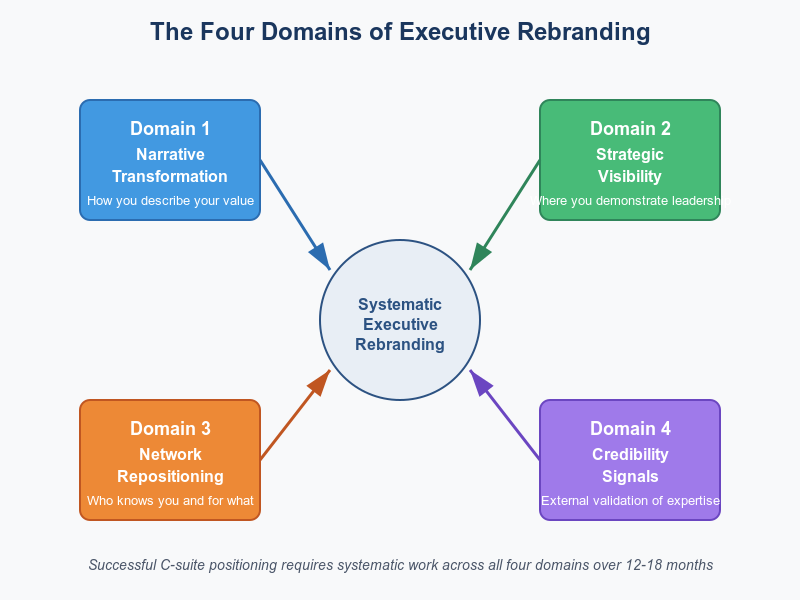
The four-domain framework for systematic executive rebranding
The single biggest barrier to C-suite advancement isn’t capability—it’s positioning. Your executive rebranding strategy must address a fundamental truth: the skills that earned you director-level success are precisely what limit your C-suite positioning.
Directors are valued for operational excellence. They execute strategy brilliantly. They deliver projects. They optimise processes. They manage teams effectively. C-suite executives are valued for strategic vision. They create strategy. They identify opportunities. They anticipate market shifts. They build organisational capability.
These aren’t just different responsibilities—they’re different value propositions requiring different executive rebranding approaches. According to Harvard Business Review research on leadership transitions, executives who successfully reposition themselves demonstrate strategic thinking consistently across multiple forums before advancement opportunities emerge.
The Operational Excellence Trap
Your operational expertise isn’t the problem—it’s how others perceive that expertise. When stakeholders describe you as “brilliant at getting things done,” they’re signalling that you’re valuable at your current level but not ready for C-suite positioning. Your executive rebranding challenge is shifting that perception from “best person to execute our strategy” to “best person to create our strategy.”
Consider what happens in C-suite succession discussions. The CEO asks: “Who’s ready for COO?” Your name comes up. Then someone says: “She’s fantastic at operations, but I’m not sure she thinks strategically about how operations creates competitive advantage.” That single sentence reflects positioning, not capability. Your executive rebranding strategy must prevent that sentence from ever being spoken.
The Four Domains of Executive Rebranding
Effective C-suite positioning requires systematic work across four interconnected domains of executive rebranding:
Domain 1 – Narrative Transformation: How you describe your value and achievements. This isn’t CV editing—it’s fundamentally reframing your professional story from operational delivery to strategic impact through deliberate executive rebranding.
Domain 2 – Strategic Visibility: Where and how you demonstrate thought leadership. C-suite advancement happens in public forums where board members and search firms observe strategic thinking. Your executive rebranding must include building this visibility.
Domain 3 – Network Repositioning: Who knows you and for what expertise. Your current network knows you as director-level; C-suite positioning requires relationships with executives who see you as peer. This network transformation is essential to executive rebranding.
Domain 4 – Credibility Signals: External validation of your strategic capabilities. Self-positioning isn’t sufficient—C-suite advancement requires third-party validation through advisory roles, speaking engagements, and industry recognition that supports your executive rebranding.
Most executives attempt executive rebranding by updating LinkedIn and CV—superficial changes in Domain 1 only. Research from McKinsey on leadership transitions shows that successful C-suite positioning requires systematic work across all four domains simultaneously over 12-18 months. Effective executive rebranding is comprehensive, not cosmetic.
Domain 1: Narrative Transformation
Executive rebranding begins with language. The words you use to describe your work signal whether you’re an operational executor or strategic leader. This transformation requires rewriting every element of your professional positioning as part of your executive rebranding strategy.
The Language Shift That Signals Strategic Thinking
Operational language focuses on “how” and “delivered.” Strategic language focuses on “why” and “enabled.” Consider these contrasts in executive rebranding approaches:
Operational positioning: “Implemented lean manufacturing across 12 facilities, delivering £8M in efficiency savings through process optimisation and team development.”
Strategic positioning: “Repositioned operations as competitive differentiator, creating £8M cost advantage that enabled aggressive pricing strategy and 40% market share growth.”
Same achievement. Different executive rebranding approach. The operational version emphasises your execution capability. The strategic version emphasises business impact and competitive advantage—the language of C-suite positioning.
CV and LinkedIn Transformation
Your LinkedIn headline and CV summary are critical for executive rebranding. These 2-3 sentences determine whether recruiters and board members see you as director-level executor or C-suite strategist.
Before executive rebranding:
“Director of Operations with 15 years delivering operational excellence. Expert in lean manufacturing, process optimisation, and team development. Consistent record of on-time, under-budget project delivery.”
After strategic repositioning through executive rebranding:
“Strategic operations executive who builds competitive advantage through operational innovation. I transform operations from cost centres to strategic assets that enable growth, market differentiation, and stakeholder value creation.”
The transformation signals C-suite positioning through several mechanisms in your executive rebranding: future-focused rather than past-focused language, emphasis on strategic value rather than operational delivery, outcome orientation (competitive advantage, growth) rather than process orientation (lean, optimisation), and value creation framing that resonates with board-level priorities.

Before and after examples of executive rebranding through narrative transformation
The Achievement Reframing Framework
Every achievement in your CV and interview responses needs strategic reframing for effective C-suite positioning and executive rebranding. Use this four-element framework:
1. Strategic Challenge: What business problem required solving?
2. Your Strategic Approach: Why did you choose this solution?
3. Implementation Impact: What changed operationally?
4. Business Value Created: How did this enable broader strategic goals?
Example of executive rebranding in practice:
Original operational statement:
“Led £12M systems implementation project, delivered 3 months early and 8% under budget.”
Strategically reframed for C-suite positioning:
“The business was scaling rapidly but operational infrastructure couldn’t support growth trajectory. I architected technology transformation strategy that balanced business continuity with modernisation, enabling the company to double revenue over 3 years whilst improving margins by 4 points. The £12M implementation was the enabler, but the strategic value was creating operational capability for sustainable growth.”
This executive rebranding approach demonstrates strategic thinking—you identified the business challenge, designed the solution strategy, and connected operational work to business outcomes. That’s the language of C-suite positioning and effective executive rebranding.
Interview Response Transformation
Interview questions reveal whether your executive rebranding has succeeded. Consider this common question: “Tell me about your greatest operational achievement?”
Operational response (limits C-suite positioning):
“I led the implementation of our ERP system across 8 countries. We delivered on time, under budget, and with minimal disruption. It was technically complex, requiring coordination of IT, operations, finance, and regional teams.”
Strategic response (demonstrates effective executive rebranding):
“The business was growing rapidly but our operational infrastructure couldn’t scale. I recognised we needed integrated systems architecture, not just better processes. I designed a phased transformation strategy that balanced business continuity with modernisation, enabling the company to double revenue over 3 years whilst improving margins. The ERP was the enabler, but the strategic value was creating operational capability for sustainable growth.”
The strategic response demonstrates successful executive rebranding: you start with business context, explain your strategic thinking, show how operational work enabled business outcomes, and frame the achievement in terms board members care about—growth, margins, scalability.
Domain 2: Strategic Visibility
C-suite positioning requires visibility. Board members and search firms hire executives they’ve seen think strategically in public forums. Your executive rebranding strategy must include building thought leadership presence beyond your organisation. According to Forbes research on career advancement, executives who maintain consistent strategic visibility advance 40% faster than equally capable peers who remain internally focused.
Why Visibility Matters for C-Suite Advancement
Internal stakeholders assess C-suite readiness partially through external validation. When you speak at industry conferences, publish strategic insights, or hold advisory roles, you signal that your expertise extends beyond your current organisation. This external validation accelerates C-suite positioning by providing independent verification of your strategic capabilities and supporting your overall executive rebranding.
Executive recruiters actively monitor industry forums, publications, and speaking circuits. Your visibility in these channels directly influences whether recruiters contact you for C-suite opportunities or director-level roles. Effective executive rebranding ensures you’re visible in the right forums for strategic leadership positioning.
The Strategic Visibility Framework
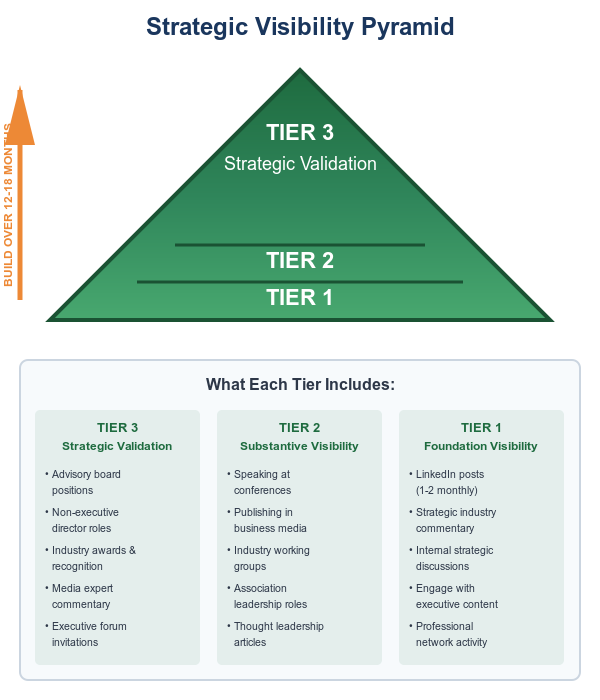
The three-tier strategic visibility framework for executive rebranding – progress from Tier 1 foundation activities through Tier 2 substantive visibility to Tier 3 strategic validation over 12-18 months
Your executive rebranding strategy should progress through three visibility tiers:
Tier 1 – Foundation Visibility: LinkedIn thought leadership posts on strategic industry trends (1-2 monthly), strategic commentary on industry developments, and documented contribution to internal strategic discussions.
Tier 2 – Substantive Visibility: Speaking at industry conferences (strategy-focused sessions, not operational how-tos), publishing articles in industry journals or business media, participating in industry working groups or standards committees, and leading industry association committees.
Tier 3 – Strategic Validation: Advisory board positions at startups or scale-ups, non-executive director roles, expert commentary in business media, and speaking at executive-level forums with C-suite audiences.
Your C-suite positioning strengthens as you progress through these tiers in your executive rebranding. Tier 1 establishes foundation credibility. Tier 2 demonstrates substantive thought leadership. Tier 3 provides the external validation that distinguishes successful executive rebranding from superficial profile updates.
Practical Visibility Strategy for Time-Constrained Executives
The primary objection to visibility work: “I don’t have time.” Effective executive rebranding doesn’t require massive time investment—it requires strategic consistency. Commit 90 minutes monthly:
Week 1: 30 minutes writing one LinkedIn thought leadership post on strategic industry trends
Week 2: 20 minutes engaging strategically with other executives’ content
Week 3: 20 minutes drafting article ideas or preparing speaking proposals
Week 4: 20 minutes networking or advisory work
This modest investment, sustained over 12-18 months, creates the visibility pattern that supports C-suite positioning and effective executive rebranding. Start small with Tier 1 activities, then systematically progress to Tier 2 and 3 as opportunities emerge.
Topic Selection for Strategic Positioning
Your visibility topics must reinforce your executive rebranding strategy. Avoid operational “how-to” topics that reinforce executor positioning. Instead, focus on strategic industry insights and future-facing analysis.
Topics that limit C-suite positioning:
“How we reduced costs by 30% through process optimisation”
“Best practices for implementing quality management systems”
Topics that enable strategic advancement through executive rebranding:
“How operational innovation creates sustainable competitive advantage”
“The strategic imperative of resilient supply chains in volatile markets”
“Building operations capability for the next growth phase”
The strategic topics position you as forward-thinking leader who understands business context and competitive dynamics—precisely the positioning required for C-suite advancement and successful executive rebranding.
Domain 3: Network Repositioning
Your current network likely limits your C-suite positioning. The people who know you—peers, mentors, recruiters—know you at director level. Executive rebranding requires building relationships with C-suite executives who see you as peer, not emerging talent.
The Network Plateau Problem
Consider who comprises your professional network today. Your peers are probably directors and senior managers. Your mentors may be VPs or first-time C-suite executives. Your recruiters contact you for director roles. This network is valuable but insufficient for C-suite positioning and effective executive rebranding.
Strategic network repositioning means building relationships with people who can provide board-level perspective, open doors to C-suite opportunities, serve as references validating your strategic capabilities, and introduce you to other C-suite executives and board members. These relationships accelerate your executive rebranding by surrounding you with people who already operate at the level you’re targeting.
The 3-6-12 Network Expansion Framework
Systematic network repositioning for C-suite positioning and executive rebranding follows a phased approach:
Next 3 Months: Identify 5 C-suite executives in your industry you want to connect with. Reach out through warm introductions or thoughtful cold outreach. Offer value—insights, introductions, or expertise—before asking for anything. Secure 2-3 informational conversations with C-suite leaders to support your executive rebranding.
Months 4-6: Convert initial conversations into ongoing relationships. Provide periodic value through relevant articles, introductions, or insights. Seek specific guidance on your strategic positioning and executive rebranding approach. Expand network to 10-12 C-suite level connections.
Months 7-12: Position yourself as peer, not supplicant. Engage these connections as your informal “board of advisors.” Ensure they understand your C-suite aspirations and capabilities. Activate network for specific opportunities and introductions that support your executive rebranding.
This systematic approach to executive rebranding through network expansion takes time but creates the relationships that directly influence C-suite advancement opportunities.
Repositioning with Executive Recruiters
Your recruiter relationships likely position you at director level. Strategic repositioning through executive rebranding requires explicit conversation about your C-suite positioning:
“I’ve been focused on director-level operational excellence. I’m now positioning for COO/CXO roles where I can drive strategic impact. I’d welcome your guidance on how to position myself for those opportunities as they emerge.”
Provide evidence of your executive rebranding: share your updated CV emphasising strategic accomplishments, reference your thought leadership and strategic visibility initiatives, and offer to discuss strategic industry trends to demonstrate your strategic thinking. This repositioning conversation transforms how recruiters perceive your capabilities and the roles they consider you for.
Domain 4: Credibility Signals
The final domain of executive rebranding addresses external validation. You can position yourself strategically through narrative, visibility, and network. But C-suite advancement requires third-party validation that others recognise your strategic capabilities. Research from the Chartered Institute of Personnel and Development demonstrates that executives with external validation advance 60% faster than those without, making credibility signals essential to effective executive rebranding.
Why Credibility Signals Matter
Board members want evidence that others recognise your strategic value. Search firms need tangible proof you operate at C-suite level. Internal stakeholders assess executive readiness partially through external credibility. Your executive rebranding must create visible signals that validate your strategic positioning.
The Credibility Hierarchy
Build external validation progressively for C-suite positioning and executive rebranding:
Tier 1 – Foundational Credentials: Professional qualifications (FCIPD, ACCA, Chartered Engineer), executive education from recognised institutions, and industry certifications relevant to strategic roles.
Tier 2 – Operational to Strategic Credentials: Speaking engagements at strategic forums, published thought leadership in respected platforms, advisory roles or consulting engagements, and industry association leadership positions.
Tier 3 – Strategic Validation: Non-executive director positions, advisory board memberships, industry awards or recognition for strategic impact, media appearances as strategic expert, and invitation to closed-door strategic forums or roundtables.
Your executive rebranding strategy should systematically build credentials across these tiers. Focus especially on Tier 2-3 validation, which often provides more immediate C-suite positioning value than additional academic credentials.
Building Credentials Strategically
The 18-month credibility building roadmap for executive rebranding:
Months 1-6: Establish foundational visibility and secure one speaking engagement demonstrating strategic thinking.
Months 7-12: Secure advisory role or board position that provides external validation of your strategic capabilities.
Months 13-18: Build consistent pattern of strategic validation through speaking, writing, and advisory work that creates undeniable evidence of C-suite positioning.
This progressive approach to external validation supports your overall executive rebranding by creating tangible proof points that distinguish you from other director-level executives seeking C-suite advancement.
Ready to Move from Recognition to Strategic Action?
You’ve recognised your career plateau (Part 1). You understand the repositioning framework (this article). Now you need structured execution with expert guidance for your executive rebranding.
The Job Search Bootcamp provides the systematic framework for executive rebranding that repositions you from plateau to C-suite advancement:
- Complete narrative transformation: CV, LinkedIn, interview responses reframed for strategic positioning
- Strategic visibility planning: Speaking, writing, and thought leadership roadmap
- Network expansion framework: C-suite relationship building strategies
- Credibility signals: Advisory roles, strategic validation, industry positioning
- 6-week structured programme with weekly accountability
- Expert coaching from executive career specialist with 20+ years supporting C-suite transitions
Investment: £899
The executives who successfully transition from director to C-suite aren’t those with the most impressive credentials—they’re those who systematically reposition with expert guidance.
The 90-Day Executive Rebranding Action Plan
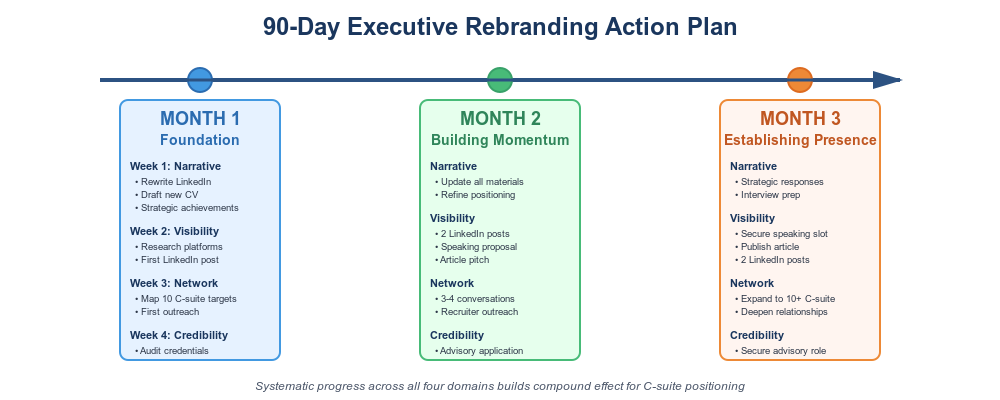
Your 90-day roadmap for systematic executive rebranding across all four domains
Understanding the four-domain framework is valuable. But executive rebranding requires disciplined execution. This 90-day action plan provides the structure for immediate progress towards C-suite positioning through systematic executive rebranding.
Month 1: Immediate Repositioning Actions
Week 1 – Narrative Foundation: Rewrite your LinkedIn headline and summary using strategic positioning language from your executive rebranding. Draft new CV emphasising strategic impact rather than operational delivery. Create 3-4 strategic achievement statements using the reframing framework. Identify 2-3 thought leadership topics aligned with your strategic positioning.
Week 2 – Visibility Planning: Research 5 speaking opportunities or article placements for next 12 months. Draft and publish your first LinkedIn thought leadership post on strategic industry trends. Identify 3 industry platforms for strategic visibility. Submit first speaking proposal or article pitch.
Week 3 – Network Mapping: List 10 C-suite executives you want to connect with over next 6 months. Identify warm introduction paths for 3-4 of them. Reach out to 2 executive recruiters to discuss your repositioning towards C-suite roles. Schedule first informational conversation with C-suite leader.
Week 4 – Credibility Audit: List current credentials and strategic validation points. Identify gaps between current credentials and C-suite positioning requirements. Research 2-3 advisory board or speaking opportunities. Begin application for relevant executive education or strategic certification if appropriate.
Months 2-3: Building Foundation
Update all professional materials with strategic positioning from your executive rebranding. Establish rhythm of 1-2 LinkedIn posts monthly minimum. Complete 3-4 informational conversations with C-suite executives. Secure first speaking engagement or article publication. Reposition with 3-5 executive recruiters about your C-suite aspirations. Apply for advisory board position or industry association role that supports your executive rebranding.
Months 4-6: Creating Momentum
Refine positioning based on feedback and market response to your executive rebranding. Deliver first speaking engagement or publish first major article. Expand C-suite network to 8-10 meaningful connections. Secure first advisory role or board position. Begin receiving inbound contact based on strategic visibility. Build consistent pattern of thought leadership across 2-3 platforms.
Measurement and Adjustment
Track these indicators monthly for your executive rebranding progress: number of C-suite relationships deepening, speaking invitations and article requests received, recruiter repositioning from director to C-suite opportunities, LinkedIn profile views from C-suite executives, and increase in strategic conversations about your capabilities.
Adjust your executive rebranding strategy if you’re not seeing traction after 3 months. Your narrative may not resonate—seek expert feedback. If visibility isn’t creating opportunities, you may need higher-profile platforms or better topics. If network isn’t expanding, your warm introduction approach may need refinement.
Case Study: James’s Executive Rebranding Journey
James, 44, served as Director of Operations at a mid-sized manufacturing company. He was brilliant at operational excellence but when the COO position opened, the board hired externally. The feedback was clear: “James is exceptional at operations. We need someone who thinks strategically.”
James recognised his career plateau and committed to systematic executive rebranding. Working with an executive coach, he invested 18 months in repositioning across all four domains of executive rebranding.
The Repositioning Strategy
Narrative Transformation: James completely rewrote his professional positioning. His LinkedIn headline changed from “Director of Operations | Lean Manufacturing Expert” to “Building Competitive Advantage Through Operational Innovation | Strategic Operations Executive.” Every CV achievement was reframed from operational delivery to strategic business impact as part of his executive rebranding.
Strategic Visibility: James committed to 90-minute monthly visibility investment. By month 6, he’d secured a speaking slot at a manufacturing strategy forum. By month 12, he’d published articles in Industry Week and begun a monthly column for a manufacturing publication. This visibility transformed how recruiters and industry leaders perceived his capabilities and validated his executive rebranding.
Network Repositioning: James systematically built C-suite relationships, connecting with 5 COOs through warm introductions in months 1-3. By months 7-9, he’d deepened these relationships and positioned himself as peer. One COO connection invited James to join a startup advisory board—providing crucial external validation of his strategic capabilities and supporting his executive rebranding.
Credibility Building: James secured an advisory board position at a manufacturing technology startup in month 8. By month 14, he’d been invited to join an industry association’s strategy committee and was featured in a “Strategic Leaders to Watch” profile. These credentials provided third-party validation supporting his C-suite positioning and executive rebranding.
The Outcome
In month 18, an executive recruiter contacted James about a COO position at a £150M manufacturing company—a role he wouldn’t have been considered for before his executive rebranding. The hiring process revealed the repositioning’s impact. The search firm noted: “We’ve been following your thought leadership. You’re clearly thinking at strategic level.” The CEO referenced James’s article on operations as competitive advantage during interviews.
James secured the role with 38% compensation increase, C-suite position with clear CEO succession potential, equity stake and full P&L responsibility, and role designing operations strategy rather than just executing it. Two years later, James reflects: “I was doing strategic thinking for years, but no one perceived it. The executive rebranding wasn’t about changing my capabilities—it was about making visible what was invisible. The systematic approach across all four domains created transformation that superficial LinkedIn updates never could.”
The Lessons
Systematic work across all four domains of executive rebranding creates compound effect. The 18-month timeline felt long but created authentic transformation for C-suite positioning, not superficial repositioning. Network development proved critical—the COO opportunity came through a recruiter tracking James’s visibility. External credentials validated his strategic capabilities when internal stakeholders couldn’t see past his operational expertise. Most importantly, James’s company saw him as exceptional director; the market saw him as C-suite executive once his strategic positioning through executive rebranding became visible.
When to Seek Professional Support
Can you manage executive rebranding independently? Yes, if you have clarity on your strategic value proposition, possess strong narrative framing skills, have access to C-suite network for feedback, can maintain 18-month commitment despite demanding role, and don’t face timeline pressure.
Consider professional support for your C-suite positioning and executive rebranding if you’re uncertain how to articulate strategic value beyond operational excellence, need accountability structure to maintain momentum, face timeline pressure pursuing specific opportunities, want to avoid 6-12 months of trial and error, or are in GCC markets navigating compressed timelines due to nationalisation.
Expert coaching provides outside perspective on positioning blind spots in your executive rebranding, proven frameworks refined across hundreds of executive transitions, accountability to maintain systematic repositioning work, network access and introduction facilitation, interview preparation for C-suite conversations, and real-time feedback on narrative, visibility content, and positioning choices.
Investment Framework
Strategic coaching sessions (£150/hour) work well for specific guidance on narrative transformation, CV and LinkedIn optimisation, network expansion strategies, or interview preparation for C-suite opportunities. Comprehensive programmes (£900-2,500) provide systematic repositioning support with structured frameworks and ongoing accountability. The Job Search Bootcamp at £899 offers complete executive rebranding framework covering all four domains with expert coaching support.
If executive rebranding enables £40,000 compensation increase in your next role, consider: coaching investment of £1,500-3,000 creates lifetime earnings impact of £200,000+ over remainder of career, timeline acceleration of 6-12 months faster transition to C-suite positioning, and confidence and clarity reducing anxiety and false starts in your repositioning journey.
Need Strategic Guidance on Specific Repositioning Challenges?
Strategic Coaching Sessions (£150/hour) provide focused expert guidance on your executive rebranding:
- Executive rebranding strategy and positioning audit
- CV and LinkedIn narrative transformation
- Thought leadership and visibility strategy
- Network expansion and C-suite relationship building
- Interview preparation for C-suite opportunities
Perfect for self-directed executives who need expert input on specific aspects of their C-suite positioning.
Your Executive Rebranding Journey Begins Today
Executive rebranding isn’t cosmetic LinkedIn updates or CV tweaking. It’s systematic work across four domains—narrative transformation, strategic visibility, network repositioning, and credibility building—that fundamentally transforms how C-suite decision-makers perceive your value proposition.
The capability you’ve built over 15-20 years deserves C-suite-level opportunity. But capability without strategic positioning limits advancement. The executives who successfully transition from director plateau to C-suite advancement share a common approach: systematic 18-month investment in executive rebranding across all four domains whilst maintaining operational excellence in current roles.
Recognition of career plateau (Part 1) was your first step. Strategic repositioning through executive rebranding is your second step. The work isn’t easy—it requires honesty about current positioning, commitment to visibility that feels uncomfortable, and patience through months of building before seeing results. But the alternative is remaining at director level, watching others advance to C-suite roles you’re capable of, accepting that operational excellence—however brilliant—isn’t sufficient for C-suite positioning without strategic executive rebranding.
What Happens Next
In Part 3 of this Executive Transition Series, we’ll explore exactly how to succeed in your first 100 days after securing your C-suite role. You’ll learn the stakeholder mapping frameworks, early wins strategies, and political navigation approaches that ensure your transition from plateau through repositioning culminates in C-suite success. We’ll cover the critical onboarding period when new executives either establish credibility or derail despite strong credentials.
For now, the critical action is commitment to executive rebranding. Recognition alone doesn’t create advancement. Strategic positioning through systematic work across all four domains creates the transformation that converts director-level plateau into C-suite opportunity.
Your executive rebranding begins today—not when conditions are perfect, not when you have more time, not when you’re more certain. The executives who achieve C-suite positioning are those who commit to systematic repositioning now, whilst maintaining excellence in current roles. They understand that waiting for “the right time” means the opportunity passes to executives who started their executive rebranding journey earlier.
A Final Note for International Executives in the GCC
If you’re an international executive in the UAE, Saudi Arabia, or broader GCC region, your timeline for executive rebranding is compressed by nationalisation policies. Begin strategic repositioning in contract years 2-3, not in your final contract year when urgency is visible and your positioning is weakened. The executive rebranding principles in this article apply universally, but your execution timeline is accelerated. Use that compression as motivation for immediate action on your C-suite positioning strategy.
Not Sure Where to Start with Executive Repositioning?
Book a complimentary 15-minute consultation to discuss:
- Your current positioning and C-suite advancement goals
- Key executive rebranding opportunities in your situation
- Whether guided support or independent approach fits your needs
- Timeline and investment framework for your repositioning
No obligation. Just clarity on your optimal path from director plateau to C-suite advancement.
Continue Your Executive Transition Journey:
Part 1 of this series: Reading the Room: When Your Current Role Has Reached Its Ceiling
Part 3 of this series: The First 100 Days: Executive Transition Implementation Plan
Related Resources:
About the Author
Richard Bunkham FCIPD is an Executive Career Coach with over 20 years of experience supporting successful executive transitions and C-suite positioning across the UK, USA, UAE, and Saudi Arabia. As a Fellow of the Chartered Institute of Personnel and Development, Richard has mentored hundreds of professionals through executive rebranding, helping them transition from director-level plateau to C-suite advancement.
Richard specialises in executive rebranding strategy, strategic career repositioning, and international career moves, with particular expertise in GCC markets and Vision 2030 opportunities. He operates Total Career Solutions Ltd and serves as an Associate Trainer at London Management Centre.
Learn more about Richard’s approach to executive career coaching and C-suite positioning