

Article Summary
To negotiate a pay rise at director or VP level, understand that the decision is made by a CFO or remuneration committee — not your line manager. Your manager is your advocate, not your decision-maker. The strongest negotiating position comes from being expensive to replace, not from presenting a better case. This guide covers how executive compensation decisions are actually made, the difference between negotiating when staying versus moving, and the specific dynamics in UK and GCC markets — written from 20 years on the hiring side.
Last updated: March 2026
Most advice on how to negotiate a pay rise is written for someone earning £45,000 asking their line manager for a 5% adjustment. At director and VP level, the game is different. The decision-maker is not your manager — it is a CFO, a remuneration committee, or a board. The package is not just salary — it is bonus, equity, pension, and in the GCC, housing, schooling, flights, and end-of-service gratuity. And the strongest negotiating position comes not from asking better, but from being so expensive to replace that the organisation cannot afford to say no.
I spent 20 years in senior talent acquisition, as Global Head of TA at various international companies. I have been the person in the room after the director leaves — the one calculating replacement cost, advising the CFO on retention risk, and recommending whether to approve, defer, or decline. What follows is what I saw from that side of the table, applied to how you should position yourself — whether you are negotiating internally in London, renewing a contract in Riyadh, or evaluating a competing offer.
What Really Happens When Directors Negotiate a Pay Rise?
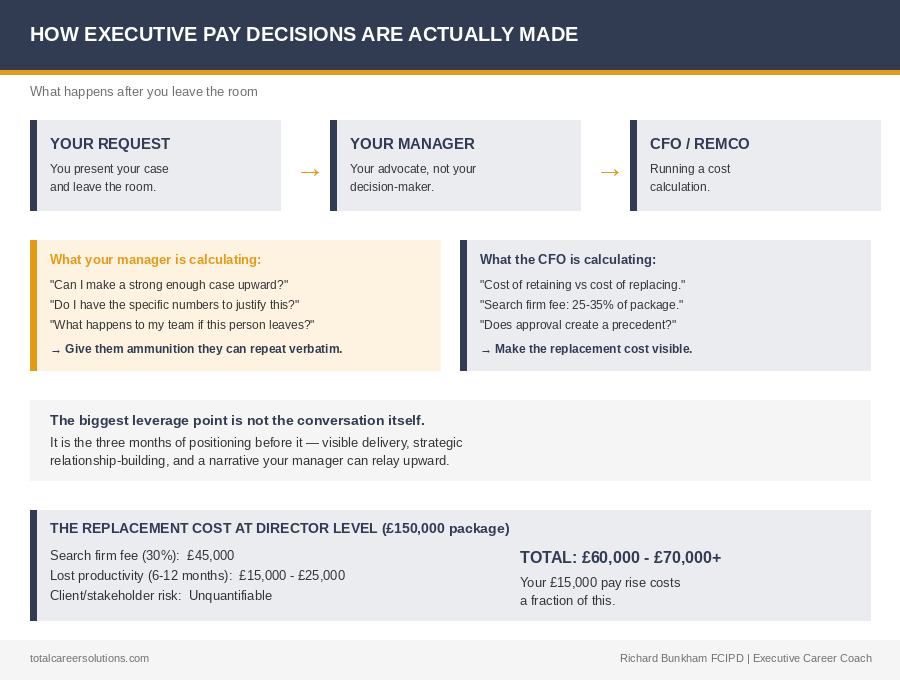
How executive pay decisions are actually made: your manager is your advocate, not your decision-maker. The CFO is running a cost calculation, not making a judgement about your worth.
At director level, your pay rise request does not get decided in the meeting where you make it. It gets decided afterwards, in a conversation you are not part of, between people whose priorities are not the same as yours. Understanding this process is the difference between a well-prepared case and a case that actually gets approved.
Your manager is not the decision-maker. They are your advocate. Their job after you leave the room is to make the case upward — to their own manager, to the CFO, or to a remuneration committee. They need to walk into that conversation with a specific, repeatable argument for why your increase is justified and why the risk of not approving it is real. If you have not given them that argument in a form they can use verbatim, they are fighting for you with their own words — and their own words will be less compelling than yours, because they do not know your contribution as precisely as you do.
The CFO is running a calculation, not making a judgement about your worth. They are comparing the cost of retaining you against the cost of replacing you. At director level, a retained executive search costs 25–35% of first-year total compensation — so for a director on £150,000, that is £37,500–£52,500 before you account for the 6–12 months it takes for a replacement to reach full effectiveness, the client relationships at risk during the transition, and the probability that the first hire does not work out. A £15,000 pay rise is cheap against that equation. But only if someone has made the equation visible.

Replacing a director on a £150,000 package costs £60,000–£77,500+ when you account for search firm fees, lost productivity, and failed hire risk. A £15,000 pay rise costs a fraction of that.
In the last 12 months, the directors I have coached through compensation negotiations have consistently found that the biggest leverage point was not the conversation itself — it was the three months of positioning before it. By the time they sat down with their manager, the case had already been built through visible delivery, strategic relationship-building, and a clear narrative of commercial impact that their manager could relay upward without having to construct it themselves.
How to Negotiate a Pay Rise When Staying: Building the Internal Case
When you negotiate a pay rise with your current employer, your leverage is your replaceability — specifically, how difficult and expensive it would be to find someone who can do what you do, at the level you do it, in the time available. Everything else — your tenure, your loyalty, your effort — is secondary to that calculation.
The research that matters at this level is not salary surveys. It is three specific pieces of intelligence. First, what your company has been paying new hires for comparable roles in the last 12 months — if external candidates are being offered more than you earn, you have an unanswerable argument. Second, what search firms have been approaching people in your team about — this tells you your market value in real time, not in annual benchmarks. Third, whether the organisation is in growth mode or cost-containment mode, because the same request gets a different answer depending on the financial cycle.
What is the AOI method? AOI — Activity, Outcome, Impact — is the framework I use with every coaching client before they walk into a conversation to negotiate a pay rise. Structure your case as: what did you do (Activity), what resulted (Outcome), and what did that mean for the organisation (Impact).
“I led the restructuring of the European supply chain” is an activity. “I led the restructuring that reduced logistics costs by £2.4 million annually and cut delivery times by 30%” is an outcome with impact. The second version gives your manager something they can repeat verbatim to the CFO. That matters, because at director level your manager is not the person who says yes — they are the person who makes the case to the person who says yes.
This is what makes director-level negotiation fundamentally different from mid-career. At mid-career, the conversation is between you and the person who controls the budget. At director level, the conversation is a relay — you brief your manager, your manager briefs the CFO or remuneration committee, and the decision is made in a room you are not in. Every element of your case must survive that relay intact. If your argument requires your personal charisma to land, it will fail in translation. If it is built on numbers, commercial impact, and replacement cost, it survives the relay and arrives on the CFO’s desk as a business case, not a personal request.
At director level in listed companies, equity and long-term incentives can represent 20–40% of total compensation. These typically include share options, restricted stock units (RSUs — shares granted to you that vest over a set period, usually three to five years), and long-term incentive plans (LTIPs — performance-linked awards tied to company targets such as earnings per share or total shareholder return). When you negotiate a pay rise at this level, these elements require a different approach than base salary — the headline grant number is often less important than the vesting schedule, the performance conditions attached, and the realistic value at exercise.
If your employer offers equity as part of a compensation discussion, assess the realistic value rather than the headline figure, and negotiate the vesting terms as aggressively as the quantum. Many directors accept equity at face value without questioning whether the performance conditions are achievable — this is one of the most common and costly mistakes I see at this level.
One thing experienced negotiators at this level consistently underestimate when they negotiate a pay rise: the timing of the ask relative to budget cycles. Most organisations set compensation budgets in Q4 for the following year. If you make your case in March, the budget is already locked — your manager may agree in principle but cannot act until the next cycle. If you make your case in September with a clear commercial narrative, your increase can be built into next year’s plan before it is finalised. The difference between a Q1 ask and a Q3 ask, with identical cases, can be twelve months of waiting.
Preparing for a Compensation Conversation?
A single focused session on your negotiation strategy — your positioning, your timing, and the specific case you need to build — is often enough to change the outcome.
Negotiating When Moving: Where the Real Leverage Lives
The most significant compensation shift for directors and VPs comes not from an internal attempt to negotiate a pay rise but from changing employers. UK data consistently shows that job-changers at senior level achieve increases of 15–25% — compared to the 3–5% typically available through internal progression. At director level, this gap widens further because every element of the package is on the table simultaneously: base, bonus, equity, pension, benefits, notice period, and exit terms.
When you negotiate a pay rise through a job move, the dynamics are fundamentally different from an internal conversation. The employer has already decided they want you — that is why they made the offer. Your negotiating position is at its strongest between the offer and your acceptance. Once you accept, every element becomes harder to revisit.
Never disclose your current salary unless legally required to. Your current compensation is an anchor — and if it is below market, it anchors the offer downward. The correct answer to “what are you currently earning?” is “I am looking for a package in the range of £X to £Y, based on the scope of this role and the market rate for comparable positions.” If a search firm placed you, use them. A good executive search consultant knows what the employer can stretch to, what comparable candidates accepted, and where the real flexibility lies — and their fee is a percentage of your package, so they have a commercial interest in your compensation being as high as possible.
Do not negotiate base salary in isolation when you negotiate a pay rise through a job move. At director level, a £5,000 difference in base salary compounded over a five-year tenure with bonus multipliers and pension contributions can represent £40,000–£60,000 in total value. Negotiate the entire package as a system, not individual elements in sequence. And negotiate the exit clause — at this level, the terms of your departure are as important as the terms of your arrival. Six months’ notice, gardening leave provisions, and accelerated equity vesting on termination without cause are all negotiable at the offer stage and almost never negotiable once you are in the role.
A pattern I see repeatedly in coaching: directors who negotiate their way into a new role focus almost entirely on the entry package and give no attention to the exit terms. Eighteen months later, when the strategy changes or the CEO who hired them moves on, they discover that their notice period is three months, their equity lapses entirely on departure, and they have no gardening leave provision. The time to negotiate exit terms is when the employer wants you most — at the point of offer. Once you are inside, the leverage is gone.
The Geography Problem: UK, GCC, and Why Context Changes Everything
How you negotiate a pay rise depends on where you are doing it. Executive compensation operates differently in different markets, and applying the wrong frame to the wrong geography is one of the fastest ways to undermine your position. The principles of leverage and positioning are universal. The mechanics of how packages are structured, what is negotiable, and where the flexibility sits are market-specific.
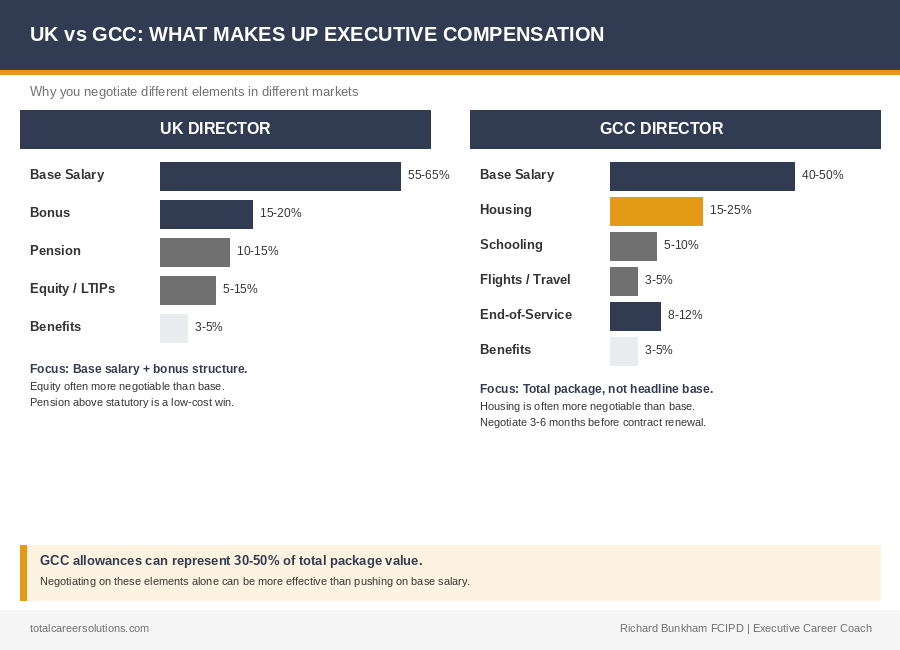
UK director compensation is base-salary heavy (55–65%), while GCC packages distribute value across housing, schooling, flights, and end-of-service — elements that can represent 30–50% of total package value.
UK Compensation: What Directors Need to Know
In the UK, executive compensation is base-salary heavy, with bonus, pension, and equity making up the variable elements. UK regular pay growth ran at 3.8% for the three months to January 2026, according to the latest ONS Average Weekly Earnings data — the first time growth has fallen below 4% since late 2021. Most employers are budgeting around 3% for pay awards this year. If you are trying to negotiate a pay rise for more than that internally, you need a specific, evidence-based reason — not a general sense that you deserve it.
The sectors showing the strongest increases are legal (4.6%), sustainability (4.1%), and accountancy and finance (3.4%), according to the Hays 2026 Salary and Recruiting Trends guide. At director level, the most effective internal negotiation often focuses on bonus structure and equity rather than base salary, because these sit outside the annual pay review budget and can be approved through different governance channels. The CIPD’s reward management guidance explains how organisations structure these decisions — understanding the internal process helps you frame your request in language your HR director will recognise.
GCC Compensation: What Expat Executives Need to Know
For international executives in the Gulf, the way you negotiate a pay rise looks fundamentally different. Total compensation includes housing allowances, schooling, flights, medical insurance, and end-of-service gratuity — elements that can represent 30–50% of the total package value. In many cases, the housing allowance alone is more negotiable than base salary, because it sits outside the formal pay band structure and can be approved at department level rather than requiring remuneration committee sign-off.
Contract renewal is the natural point at which GCC-based executives negotiate a pay rise — but the leverage exists three to six months before renewal, not during it. Once you are in the renewal conversation, the employer already knows you are staying. The negotiation should begin well before that point, with your case already built and your market intelligence already gathered. If you are navigating a GCC contract renewal, the broader structural context matters — Saudisation and what it means for expat executives covers the changes affecting compensation and career longevity across the region.
The NEOM Problem: When Your Salary Expectations Are Anchored to an Anomaly
This is one of the most difficult compensation conversations I have with coaching clients, and it is becoming more common as giga-project contracts end and professionals re-enter the broader market. If you joined NEOM, Red Sea Global, Qiddiya, or another PIF-backed programme at peak, your package was almost certainly inflated — sometimes by 30–50% above equivalent roles in established organisations. Those packages included hardship premiums for remote locations, risk premiums for unproven organisations operating at extraordinary pace, and golden handcuffs designed to prevent early departure.
That premium was real and it was earned. Building a city in the desert or delivering a $500 billion programme on an accelerated timeline is not the same as running operations in an established Dubai corporate. But the premium was also specific to those conditions. The next employer — whether in the GCC or elsewhere — will not pay NEOM rates for a role that does not carry NEOM-level risk, remoteness, or pace. Your salary expectation is anchored to an anomaly, and the market does not share that anchor.
The strategic response is not to accept a pay cut — it is to reframe what you negotiate a pay rise for. Total package value, not headline base salary. Equity participation if moving to a listed company. Performance-linked bonuses that reflect your track record of delivery at scale. A title and scope that positions you for the next move, not just this one.
The reframe that works in coaching is this: a director who earned £250,000 at NEOM and takes a role at £180,000 with equity that vests at £40,000–£60,000 over three years, in an established organisation with genuine career progression, has not taken a pay cut — they have traded a short-term premium for long-term career value. The total compensation over five years may be higher. The career trajectory is stronger. The CV reads better. The directors who navigate this transition successfully are the ones who separate their NEOM-era expectations from their long-term career strategy — and negotiate from a position of strength rather than defensiveness about a number that no longer reflects the market.
The Mistakes That Cost Directors Who Negotiate a Pay Rise
At director and VP level, the mistakes that cost you are different from those at mid-career — and they are rarely the ones that standard negotiation advice warns about. These are patterns I have seen repeatedly from the hiring side, where otherwise strong candidates damaged their position through errors of judgement rather than errors of preparation. One pattern is consistent enough to be worth stating directly: the directors who fail in compensation negotiations almost always fail on positioning, not on technique. They walk in with a well-rehearsed case but without three months of visible delivery behind it — and the case, however polished, lands on a CFO who has no recent evidence to attach it to.
Playing search firms against each other transparently is the first. At this level, the executive search community is small and well-connected. If you are working with Korn Ferry on one opportunity and Heidrick on another and using each to pressure the other, both firms will know within days. Your reputation as a candidate is an asset — do not spend it on short-term tactical games.
Accepting a title promotion without a compensation review is the second. A title costs the organisation nothing. It creates the impression of progression without the substance. If your employer offers a title change without a corresponding adjustment, understand what they are actually doing: they are resetting your expectations upward on responsibility while keeping your cost flat. If you negotiate a pay rise, insist that the title comes with a compensation review — not instead of one.
Disclosing your current salary when you do not have to is the third. In the UK, there is no legal requirement to disclose your current compensation to a prospective employer when you negotiate a pay rise through a job move. Every time you disclose, you anchor the negotiation to your current number rather than the market rate for the role. At director level, where the gap between your current compensation and the market rate can be £20,000–£40,000, this anchor costs real money.
Negotiating emotionally after being passed over internally is the fourth. If you have been overlooked for a promotion or a pay rise you believed you deserved, the temptation to negotiate a pay rise from frustration is strong. But frustration is the worst possible foundation for any attempt to negotiate a pay rise. The directors who handle this well separate the emotional response from the strategic response — and often find that the right move is not to negotiate harder internally but to take the search firm’s call.
The Strategic Question: Push for More or Move On?
If you have been told no to a request to negotiate a pay rise twice despite strong performance, the organisation is telling you something about where you sit in their priority stack. This is not necessarily a reflection of your value — it may be a reflection of budget constraints, internal politics, or a strategic direction that no longer centres your role. But the signal is the same regardless of the cause: your upward trajectory in this organisation has stalled.
What is the DVA framework? DVA — Discover, Vision, Action — is the coaching methodology I use to help directors and VPs think through this decision strategically rather than reactively. Discover: assess where you actually stand — your market value, your internal trajectory, and the honest probability that the next 12 months look different from the last 12.
Vision: define what you are negotiating toward — not just a number, but a role, a level of responsibility, and a market position that supports your five-year career plan. Action: build the case, choose the timing, and execute — whether that means one more internal push to negotiate a pay rise with a materially different approach, or a well-prepared move to an organisation that values what you bring.
The data supports moving more often than most directors expect. Job-changers at senior level achieve 15–25% compensation increases, and in the GCC the differential can be even wider because package components multiply across base, housing, schooling, and end-of-service. But moving has costs too — relationships, organisational knowledge, and the 6–12 months it takes to build credibility in a new environment. The decision should be strategic, not emotional. If you are weighing this up, the 7 signs it is time to change jobs may help you assess where you stand.
If you are preparing to negotiate a pay rise — whether internally, through a job move, or at contract renewal in the Gulf — the starting point is understanding your specific position: your market value, your replaceability, and the dynamics of the organisation you are negotiating with. That assessment is exactly what career coaching is designed to provide. One focused session on your negotiation strategy is often enough to change the outcome.
Ready to Negotiate From Strength?
Whether you are building an internal case, evaluating a competing offer, or navigating a GCC contract renewal — a 15-minute strategy call gives you a direct assessment of where you stand and what approach will work in your specific situation.
P.S. Preparing for a director or VP compensation conversation? DM “Compensation Strategy” on LinkedIn and I will send you the Executive Compensation Negotiation Checklist — a one-page PDF covering the key questions to answer before any negotiation — plus a complimentary 15-min call.